Geography Lessons on Palate Art | How Does 'Tasting Mountains and Rivers in Micro Space' Make Landscapes Palatable?
Read, share, and explore related stories through curated categories and tags.

If there is an inspiration that can make the cup of tea latte cradled in your hands precisely transport you to a specific geographic coordinate of a city; if what you swallow is not just the flavor, but also the unique waterfront boundaries of that land, the outlines of its forests, and the enduring, ever-living natural beings across time…
China National Geographic • Art Geography is trying to turn this poetic imagination of the land into a tangible reality.

On May 21, as the lights of the 22nd Shenzhen Cultural Expo lit up in that vast exhibition hall brimming with countless cultural inspirations and hurried footsteps, a specially curated “Mountain and River Sipping Micro-Space” by China National Geographic · Art Geography quietly settled in.
In the heart of the expo, where hustle and efficiency intertwine, it felt more like a “Terroir Living Room” left by nature in the urban center. Here, the grasses, soil, and monsoon winds from the land gently invite you over a cup.

China National Geography · Art Geography at the Shenzhen Cultural Expo Booth
It’s not just an ordinary pop-up drink stand, but an immersive story about using tea and coffee—beloved by young people—as a medium, grounded in geographic science, to “savor” the local terroir.
For over 70 years, China National Geography has crossed mountains and seas, capturing the vastness and subtlety of this land through lenses and words. But this time, China National Geography · Art Geography chose a gentler approach—breaking the boundaries of the senses and translating grand geographic science into the warmth felt on the palate.
Once you’ve sipped the specially blended sweetness and slight bitterness, the hardcore knowledge about tides rising and falling, mountain ranges undulating, and mangroves “excreting salt” is no longer just cold text in geography textbooks. It becomes warmth on your tongue, a trace of grass and wood in your mouth.
The stories of the earth are engaging in a deep dialogue with the people of the city, unfolding with every clink of cups.

The landscapes of nature never clamor; they simply quietly become the most beautiful “backdrop” in your splendid years.
Stepping into the “Mountains and Rivers Tiny Tasting Space,” the design similarly breaks the rigid boundaries of display, dissolving the activation of content into every breath of the scene.

This is an “open interactive bar” without any commercial distance
The fully open design allows everyone who stops by to immersively experience the “magic” of a drink transforming from its native ingredients into a new-style beverage. The act of getting a drink is redefined—it’s no longer a simple order, but a full sensory interaction with the essence of the land’s bounty.
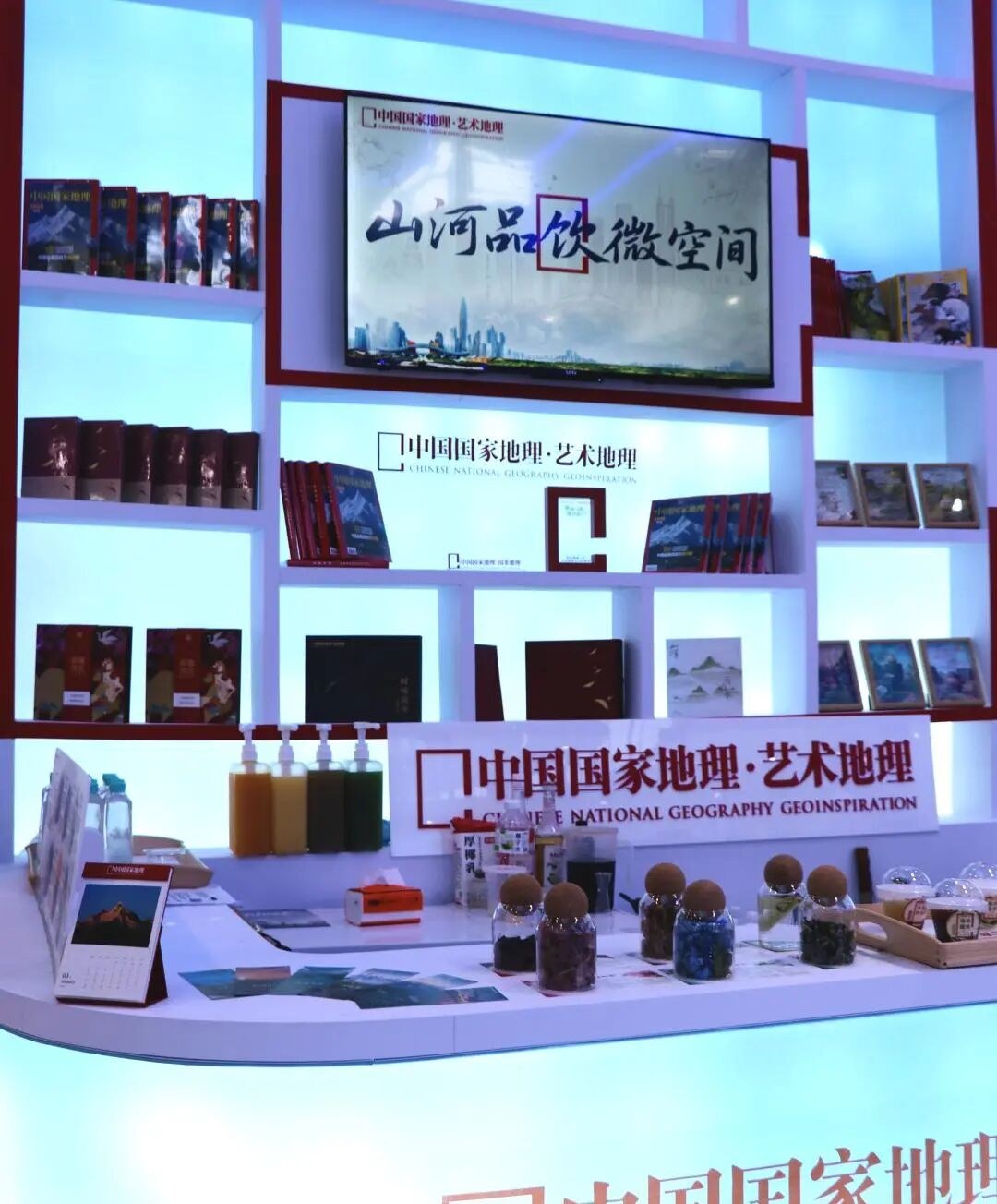
China National Geography · Art Geography Full Open Bar Booth
This is a “Scientific Invitation” to Read the Land
Around the bar, professional science exhibition boards are scattered, detailing the deep scientific connections between limited-edition flavors and their corresponding geographic landmarks. Rigorous geological research and poetic flavor language collide and intertwine here, creating a “terroir cool island” within the bustling exhibition center that makes people unconsciously slow down and read with focus.

Futian Geography Science & Drink Inspiration at China National Geographic · Art Geography Exhibition


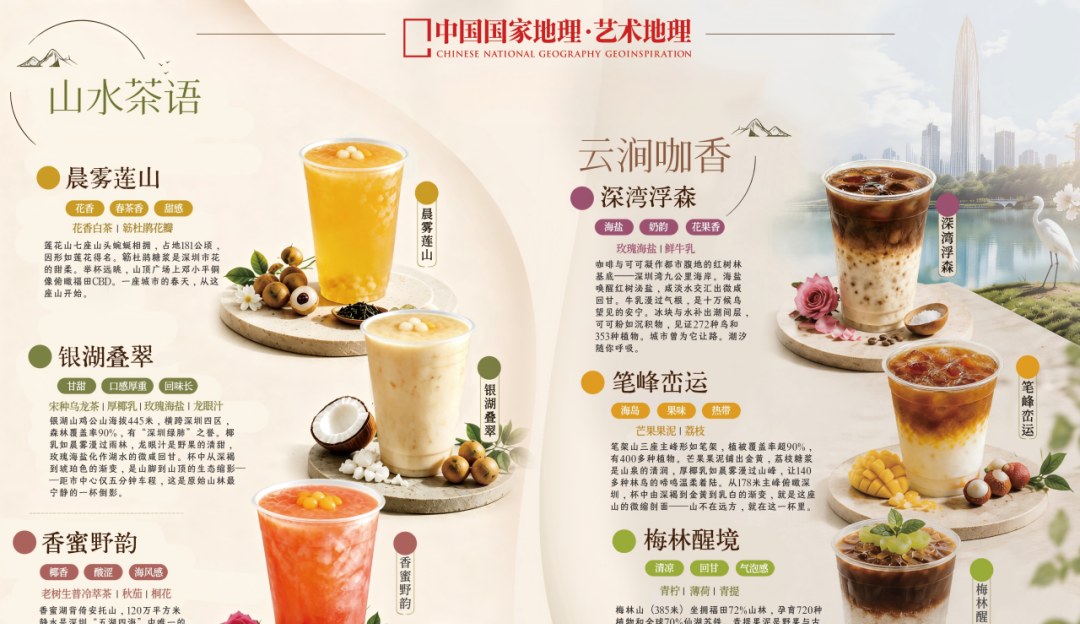
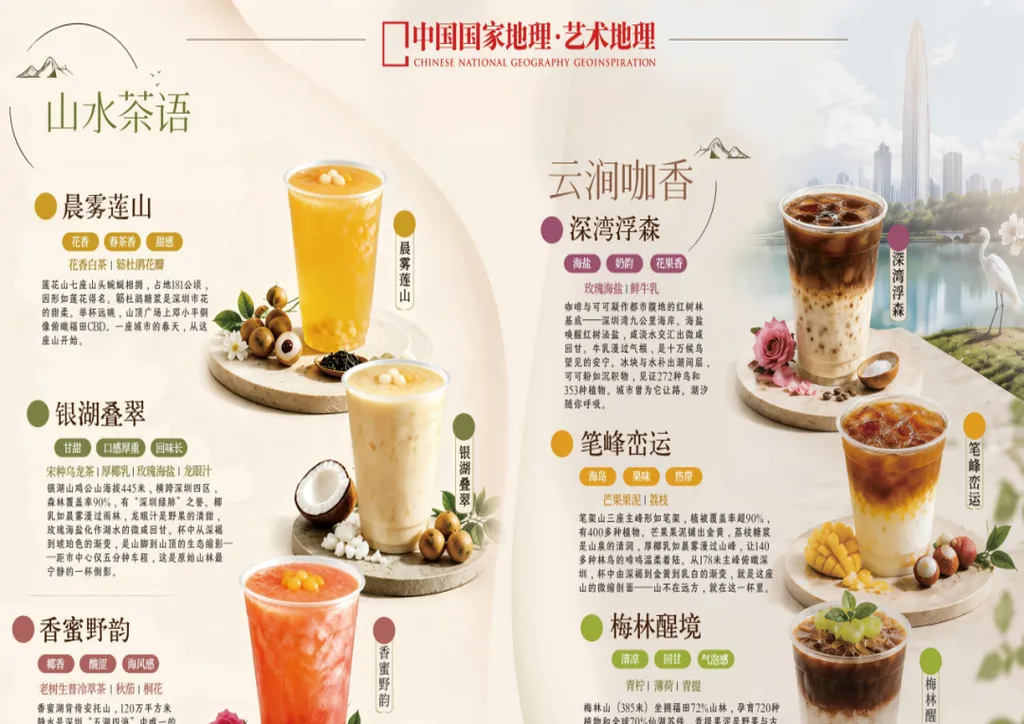
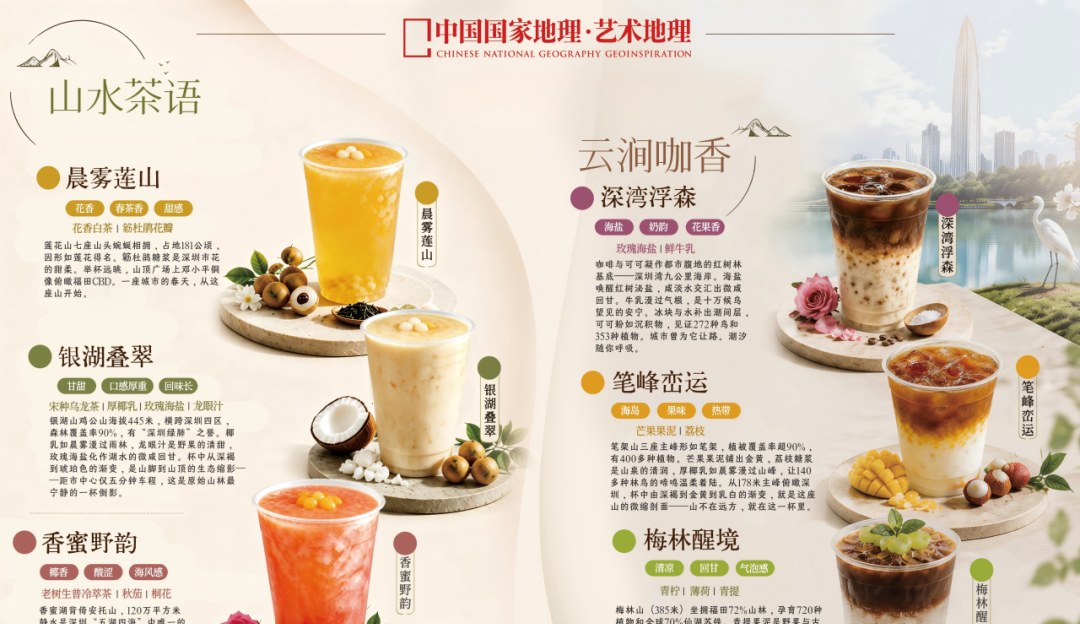
China National Geography • Artistic Geography has developed six beverages based on the geographical elements of Futian District.
This tasting experience takes Futian District—the central backbone of Shenzhen—as the terroir study blueprint. Based on the unique ecological elements and scenic spots of this land, the real natural scene has been precisely translated into six customized flavors.

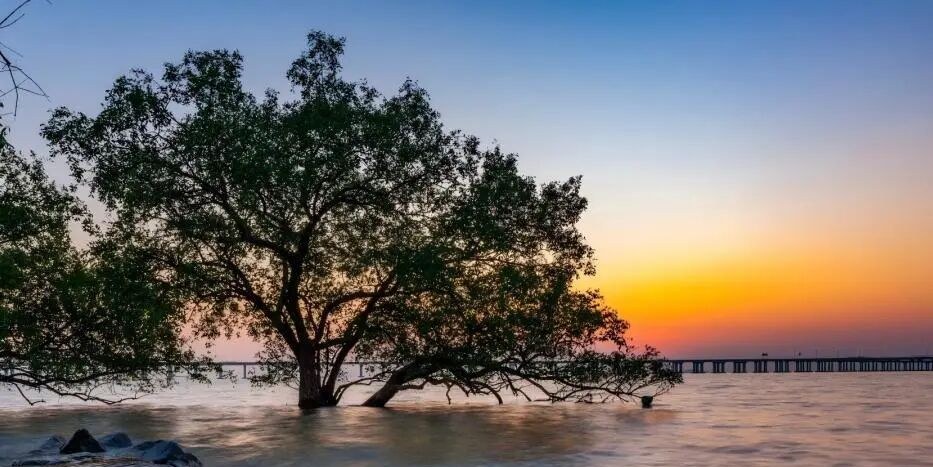
Shenzhen Bay Mangrove Forest in Futian District, Shenzhen. Shenzhen Bay is a drowned valley estuary shaped by the tides of the Pearl River Estuary and the Shenzhen River basin. Within this national nature reserve tucked into the heart of the city, a nine-kilometer coastline winds along. Mangrove plants anchor the mudflats in the intertidal zone with their well-developed prop roots and breathing roots, while their leaf salt glands expel excess salt, creating a three-dimensional ecological network for flora and fauna.Deep Bay Floating Mangroves: China National Geographic · Artistic Geography brings Shenzhen Bay’s unique geography to life.
In the translation of flavors, the deep melancholy of coffee and cocoa is brewed into the muddy foundations deposited over millennia in the tidal flats; a drop of rose sea salt quietly awakens the ancient survival memory of mangroves secreting salt. As fresh milk surges like the rising tide over the deep brown of cocoa, a blend of salty and sweet washes over the tongue, like tidal waters soaking into intricate aerial roots. This is the tranquil color seen by nearly 100,000 migratory birds along the East Asian-Australasian Flyway. The city once made way for it, and now, the tides rise and fall with every breath in your cup.
Bijia Mountain in Futian District, Shenzhen ( The three peaks of Bijia Mountain stretch from east to west, formed by hundreds of millions of years of Yanshanian granite undergoing differential weathering, leaving behind pen-shaped residual hills in the city center. Nourished by the South Asian subtropical monsoon climate, the mountain uniquely retains a natural secondary forest in the heart of the city, with vegetation coverage exceeding 90%. This mountain park nurtures over a hundred plant species, hides more than a hundred kinds of small birds and animals, and boasts lush, moist vegetation deep within its forested valleys.Mountain Peaks and Ridges: China National Geography · Artistic Geography developed based on the geographical features of Bijia Mountain
To convey this lush southern greenery, rich and thick mango puree spreads down the bottom of the glass, recreating the dense texture of lush valley vegetation. Thick coconut milk melts on the tongue like morning mist, while the clear, ethereal note of lychee suddenly emerges, like the darting figures of small birds and animals weaving through forest corridors. This is a glass of vibrant energy nurtured by the tropical monsoon, where between the rolling mountain ridges and the calls of the magpie robin, you can taste the wildness of the urban forest in one sip.
Meilin Reservoir in Futian District, Shenzhen. As the most important urban drinking water source regulation and storage reservoir along Shenzhen’s central axis, Meilin Reservoir precisely locks in the clear runoff from the foothills of Meilin Mountain. This urban primeval forest rests upon a granite bedrock base formed over hundreds of millions of years, nurturing a diverse range of plants and animals vertically—from valley monsoon rainforests and lowland evergreen monsoon forests to mountain evergreen broadleaf forests. Among them are over 70% of the world’s wild Cycas fairylake populations, forming a cold-source lung within the heat island through its grassy slopes and secondary forests.Meilin Awakening: China National Geographic · Art Geography develops based on the geographical features of Meilin Reservoir.
In the glass, the cold, bright natural mineral acidity of lime is chosen to strike and awaken the dormant granite base; the herbal coolness of mint spreads through the mouth, like a breeze brushing over the layered green of a valley. Finally, the sweet freshness of green grapes gathers the ancient vitality of the aquatic plants thriving in the reservoir’s fluctuating water zone. Geological breath and the epic of species reconcile in the pure aftertaste of cold-brew coffee, recreating the first chill of dawn on Meilin Trail, evoking a memory of a ‘waking realm’ that isolates you from the noise.
Lianhua Mountain in Futian District, Shenzhen Photo: De Le
Standing at just 106 meters above sea level, Lianhua Mountain is made of solid granite, shaped like a cluster of giant lotus petals, precisely embedded along Shenzhen’s central axis. As the last preserved piece of original low-hill vegetation in the city center, it retains the most typical south subtropical monsoon evergreen broad-leaved forest community structure. Every summer, moisture brought by the southeast monsoon rises here, creating a localized microclimate, where flamboyant trees, jacarandas, and bougainvillea (Shenzhen’s city flower) bloom luxuriantly at the summit.Morning Mist Lotus Mountain: China National Geography · Artistic Geography, developed based on the geographical features of Lotus Mountain.
This drink captures the light, swaying form of bracts from the bougainvillea in the South Asian tropical monsoon community. With the delicate fragrance and slight bitterness of floral white tea as the main note, it slowly seeps into the steady foundation of granite. Then, a syrup made from dried bougainvillea flower water is gradually infused—petals shape the form, tea infuses the essence, recreating in the cup the bright, vivid flavor of dawn mist dispersing over Lotus Mountain’s peak and the sudden pour of southern sunlight. With every sip, you drink in the blooming hills and gentle slopes of this city’s mountain forest.
Yinhu Mountain in Futian District, Shenzhen. Photo The main peak of Yinhu Mountain stands at 349 meters above sea level, with a forest coverage rate as high as 90%, making it the largest mountain forest and water conservation area in central Shenzhen. It sits precisely within the branch influence zone of the Shenzhen fault belt, with rocks primarily composed of Jurassic volcanic rock and granite. Abundant rainfall, intercepted by the forest canopy, absorbed by leaf litter, and filtered through soil, **has, under the long-term weathering of the fault belt, created rich surface runoff among the forest valleys and serene catchment depressions.**Silver Lake Overlay: China National Geography’s Art Geography series draws on the unique features of Silver Lake Mountain.
In terms of flavor design, a Songcha Oolong Tea with a deep, rocky undertone is deliberately chosen as the base, capturing the rugged essence of Jurassic volcanic rock and geological fault zones. Smooth thick coconut milk gently spreads out, recreating the abundant underground supply beneath the lush forest canopy. The soft, clear sweetness of longan juice is the sweet echo of life nurtured by the waters gathered in the deep mountain valleys, offering a view of the twin-city skyline as you look up.
Xiangmi Lake in Futian District, Shenzhen. Nestled against Antuo Mountain to the north and facing Shenzhen Bay to the south, Xiangmi Lake receives natural runoff from the northern ridges. Over a waterfront green space of more than 200,000 square meters, it has formed a complete waterfront ecological gradient composed of “submerged shallow-water plants—emergent plants—riparian vegetation.” Spanning 1.2 million square meters, this vast expanse of open water is the only still water body in the city’s central ecological living room. Nearly 70,000 birds have already nested and thrived here before humans, **gently balancing the microclimate of the surrounding neighborhoods.**Fragrant Honey Wild Charm: Developed based on the geographic features of Xiangmi Lake by China National Geographic · Art Geography
This special blend uses natural old-tree raw pu’er as its flavor core, with its unique natural astringency precisely mimicking the saline-alkaline undertones of the soil and water in this waterfront area. The slight saltiness from the kandelia candel extract reflects the tenacity of mangrove breathing roots as they take hold where fresh and saltwater meet, softening the impact of tidal surges. The faint bitter note of sea trumpet flower in the finish delicately traces, through the evolution of tea notes, Xiangmi Lake’s forty-year urban narrative—from a saline-alkaline mudflat to today’s sprawling city waterscape.The secrets of the earth are often hidden in those subtle, unnoticed sensations. To bring these geographic codes to life in a more vivid way, Microspace has transformed complex popular science into a visually rich “immersive exploration journey.”
Step One: 【Awaken the Senses】Scent Your Way Through Geography
Here, you are no longer just an observer behind glass. Step up to the native plant display area by the bar, close your eyes, and take a deep breath: you can not only smell the faint, salty sea breeze lingering on the leaves of the Kandelia obovata but also catch the subtle, gentle fragrance of bougainvillea baking under the southern sun. This is nature’s most primal scent—and the first key to unlocking Futian’s local character.
China National Geography · Artistic Geography: “Native Plants” in Six Beverages
Step 2: [Tasting the Landscape] First Impressions on the Palate
Find a seat at the bar and take a cup of freshly brewed special blend. As the slightly chilled cold brew or the warm, smooth tea slides down your throat, the vast granite bedrock, the rise and fall of the tides, and the rustle of the monsoon instantly take shape between your lips and teeth. The symphony of nature is condensed into that small cup, and with every swallow, it feels like you’re tracing the spiritual contour lines of this city with the tip of your tongue.Audience members enjoy creative tea and coffee at the “Mountain and River Micro-Space.”
Step 3: 【Fold the Land】Leave a Mark
Before leaving, slip a custom postcard printed with meticulous natural history notes into your pocket. As your fingertips trace the contour lines and illustrations of flora and fauna on the paper, you take away not just a unique geographical memory of Futian, but also the breath of this land, gently folded into your own pocket.While enjoying a drink, you can receive a complimentary “terroir postcard” inspired by its geography.
This entire micro-space achieves a remarkable cultural experience leap: the complex monsoons and ocean currents are no longer passive science facts hanging on the wall, but become an active journey you can see, smell, and taste. The spectator turns into an explorer—within this small space, you can still see the world.When we zoom out, this small bar counter carries not just a fleeting encounter at the exhibition, but also a profound exploration of how to tell the story of a place.
When the imagery, geology, and natural history studies accumulated by Chinese National Geography over more than 70 years are distilled, reorganized, and ultimately infused into tiny cups and spaces, grand science breathes and takes on a temperature that can be tasted. **Here, romance becomes another language of science.**China National Geography · Art Geography “Shanhe Pin Yin Micro Space”
Every creation of nature, every geographical unit worn down by time, holds deep spiritual clues yet to be awakened. From the initial terroir research and inspiration discovery, to customized flavor development and the poetic presentation of space, this model can be seamlessly applied to any landscape, neighborhood, or scenic area. It acts like a key to content activation, opening a door to multi-dimensional sensory immersion for urban cultural tourism enhancement, local industries, and ecological study tours, giving spaces longer-lasting vitality.
This flavor translation based on the six landmarks of Futian is a romantic experiment about the earth. It conveys a steadfast belief to the industry: **In this world, no land is dull. As long as we observe with rigorous science and translate with artistic sensibility, any unique geographical coordinate can distill its own spiritual totem.**The geographical elements of Futian District that serve as the foundation for the beverage development of China National Geography · Art Geography
When the clamor in the exhibition hall fades away, what lingers in visitors’ memories might be the faint bitterness of an aged raw Pu’er, or the graceful canopy line on a terroir card. The warmth of a cup of tea or coffee, and the keepsake of a postcard, stretch the moments of lingering footsteps, gently turning the natural wonders, the vicissitudes of the land, and the vibrancy of everyday life into an enduring, irreplaceable core charm of this destination.”Mountain and River Tasting Micro-Space” is not only a limited exhibition experience for the fair, but also a deep practice by China National Geographic · Artistic Geography in the integration of culture, geography, and cultural tourism.
We sincerely invite colleagues and partners to join us, listen to the direction of the monsoon, savor a cup of inspired tea or coffee, and explore the world of latitude and longitude.
See you at the Cultural Expo!
China National Geographic · Artistic Geography 丨 Booth Guide
Tasting Time 丨 May 21–25, 2026
Booth Location 丨 Shenzhen World Exhibition & Convention Center · Hall 15, Guangdong-Hong Kong-Macao Greater Bay Area Pavilion, Booth B45
ENDWriter: Xiang Jingfang
Layout: Xiang Jingfang
Editor: Gao Yuan
Tag navigation
Explore articles that share the same tag and jump to tag pages.
Geografie zum Genießen: Wenn Chinas Landschaften als Tee und Kaffee im Glas landen
Geographieunterricht für die Geschmacksknospen | Wie lässt der „Berg-und-Fluss-Genuss-Mikroraum“ Berge und Flüsse schmecken?
Achtseitige Sonderbeilage der China Tourism News! Wenn die Schätze Shandongs zu einer langen Rolle der Qi- und Lu-Kultur werden
Category navigation
Jump to the article’s category or explore nearby topics.
Wenn man jemanden zum Essen einlädt und die andere Person sagt „Ich kann nicht, es ist etwas dazwischengekommen“, sagen Sie nicht „Okay, dann ein anderes Mal“. Hier kommt die Antwort mit hoher emotionaler Intelligenz.
Jump to the more recent article in this topic series.
Die lästige chinesische Küche
Continue to the previous article in this series.
Related stories
More articles from the same category and nearby topics.