Chinese Landscape Architecture · New Issue Guide|Landscape Architecture——The Science and Art of Surface Space Management and Shaping (Full Text Available for Download)
Read, share, and explore related stories through curated categories and tags.
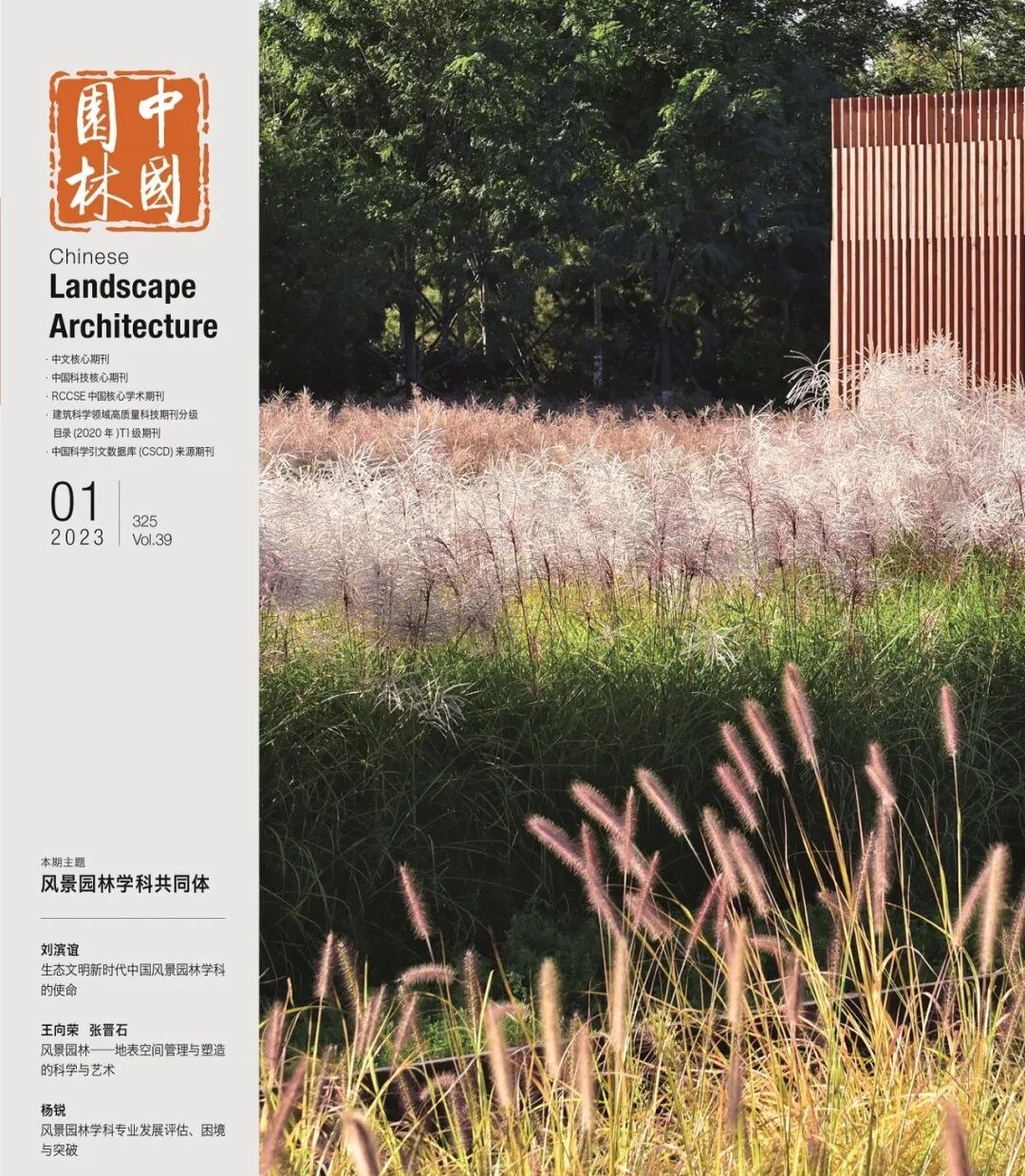

Landscape Architecture—
The Science and Art of Earth Surface Space Management and Shaping
Author
Wang Xiangrong/WANG Xiangrong
Professor and Doctoral Supervisor, School of Landscape Architecture, Beijing Forestry University/Editor-in-Chief of this Journal
Zhang Jinshi/ZHANG Jinshi
Professor and Doctoral Supervisor, School of Landscape Architecture, Beijing Forestry University/Special Editor of this Journal
Full text published in Chinese Landscape Architecture 2023-01 issue P14-22
Click on the mini-program at the end of the article to download the full text.
Citation format for this article: Wang Xiangrong, Zhang Jinshi. Landscape Architecture: The Science and Art of Earth Surface Space Management and Shaping [J]. Chinese Landscape Architecture, 2023, 39(1): 14-22.
Abstract: This paper reviews the professional definitions and interpretations of Landscape Architecture both internationally and in China, and proposes the definition, purpose, and goals of landscape architecture. By analyzing two types of earth surface space, it elaborates on nine approaches to achieving the purpose and goals of landscape architecture. Furthermore, it puts forward three sources for the theoretical framework of landscape architecture: the evolutionary laws of natural systems, the experience and ideas of land use and earth surface shaping before industrialization, and the concepts of constructing built environments reliant on nature after industrialization. It also discusses solutions based on nature, culture, and problem-solving for future practice, aiming to provide reference for the research and practice of landscape architecture in China.
Keywords: landscape architecture; earth surface space; management and shaping; natural systems; land use; built environment construction; future practice
1
Re-understanding Landscape Architecture
With a deepening understanding of the relationship between humans and nature, the practical content, theoretical research, scale scope, service objects, and working methods of landscape architecture are expanding. Countries, international organizations, and even individual landscape architects have their own definitions and interpretations of Landscape Architecture, with a common focus on achieving sustainable, harmonious development between humans and nature through land planning, design, and protection. Synthesizing existing research and practice in landscape architecture, we can define it as: Landscape architecture is a comprehensive discipline concerning the management and utilization of earth surface space. Aimed at coordinating the relationship between humans and nature, it uses scientific and artistic means to protect natural areas on the earth’s surface and establish a complete ecological support system within built environments, thereby maintaining sustained harmony and balance between people’s use of land and the ecological environment.
The research and practice objects of landscape architecture encompass the entire earth surface space. By defining the degree of human interference and the ecological service functions and cultural values possessed by nature and its ecosystems, the entire earth surface space can be divided into two types from the perspective of landscape architecture: natural earth surface space and artificial earth surface space.
The means to achieve the purpose and goal of maintaining sustained harmony and balance between artificial construction and nature across the entire landscape are through a series of professional methods, including research, evaluation, protection, restoration, planning, design, construction, and maintenance, for scientific management and utilization of earth surface space. Broadly, there are two approaches for natural earth surface areas: 1) Protect and maintain natural processes, allowing them to develop according to their own laws; 2) Conduct artificial construction following the principle of minimal environmental impact, without altering the overall evolutionary process of nature. For artificial earth surface areas, there are seven approaches: 1) Rational development and utilization to reduce negative impacts on nature and promote ecosystem development in a positive direction; 2) Establish complete and continuous natural systems to support human construction and various intervention activities; 3) Give ecological value to non-natural spaces; 4) Conduct ecological restoration on damaged environments; 5) Ensure the sustainability of cultural evolution and development; 6) Provide reasonable, high-quality living environments for humans while ensuring aesthetic and artistic value; 7) Rewilding and re-wilding.
2
Sources of the Theoretical System of Landscape Architecture
The theoretical system of landscape architecture originates from the evolutionary laws of natural systems, the experience and ideas of land use and earth surface shaping before industrialization, and the concepts of constructing built environments reliant on nature after industrialization (Figure 1).Figure 1 Theoretical Framework of Landscape Architecture
Natural laws guide and lay the foundation for landscape architects to develop scientifically sound planning and design concepts. Through a comprehensive understanding and application of natural science knowledge, landscape architects play a unique role in the integrated planning and design process. Natural systems and their evolutionary patterns are one of the theoretical sources of landscape architecture.
Before industrialization, different countries had their own experiences and ideas in shaping the earth’s surface, forming traditional adaptive approaches to human-land relationships. Western traditional gardening applied adaptive techniques and methods of human-land relationships to gardens around living environments, creating geometric compositions and spatial relationships composed of elements such as orchards, flower beds, and canals. By the 17th and 18th centuries, people began consciously to manage, transform, and maintain large-scale landscapes, with specific examples including the Palace of Versailles, the Dessau Garden Complex, regional landscape planning in Potsdam and Berlin, Muskau Park, Ermenonville, and Hirsch’s landscape management plan, reflecting the close integration of landscape with society, economy, environment, and cities. China, on the other hand, developed systematic land-use methods adapted to nature, forming a unique human-natural ecosystem and constructing a foundational land structure where artificial and natural elements merge and influence each other. Chinese garden culture is distinctive, achieving remarkable success. The Chinese understanding of nature, the pursuit of culture and art, combined with land-use practices adapted to geography and climate, have together shaped a national landscape where mountains and waters coexist, artificial and natural elements intertwine, and rivers, canals, lakes, fields, forests, and cities blend into one. China also has a tradition of landscape perception and planning practice that is broad in scope, comprehensive in value, and long in duration, requiring continuous exploration, organization, and ongoing inheritance and innovation. The pre-industrial practices and experiences of land and landscape planning, based on adaptation to nature and culture with cultural and aesthetic value, are among the most important theoretical sources and foundations of modern Chinese landscape architecture.
After industrialization, modern landscape architecture emerged and developed in response to severe environmental and social problems caused by industrialization, giving rise to ideas for constructing artificial environments based on nature. These include: national parks, cultural landscapes, parks and park systems, garden cities, ecological networks, greenways, scenic byways, green/ecological infrastructure, landscape/ecological urbanism, ecological restoration, brownfield regeneration, near-natural design, urban wilderness, low-impact development, sponge cities, urban renewal, resilient design, and geodesign. These ideas, formed through the development of modern science and technology to address challenges in nature, culture, society, and cities, represent the third most important theoretical source and foundation of modern landscape architecture.
3
Solutions for the Future Practice of Landscape Architecture
The future practice of landscape architecture will also be based on a comprehensive understanding and application of natural science knowledge, historical experiences and ideas in land use and earth surface shaping, and post-industrial artificial construction concepts. This will lead to innovative solutions grounded in nature, culture, and problem-solving, aimed at addressing challenges in natural and built environments and achieving sustainable development in culture, economy, and ecosystems.
4
Conclusion
With social development, technological progress, and changes in the human living environment, the surface spaces that people can manage, intervene in, and influence are increasingly broad. From uninhabited natural surface spaces to rural areas and high-density urban spaces occupied by humans, a continuum of varying human modification intensity has formed, ranging from very weak to very strong. Different surface spaces, due to their differing degrees of naturalness and artificiality, have distinct natural processes and ecosystem services, as well as significantly different land-use methods and cultures. Scientific understanding and accurate perception of these surface spaces are the foundation for rational land use and development planning, and different management approaches emerge based on human and natural needs.
China has its unique natural, geographical, historical, cultural, social, and economic conditions. Chinese landscape architects can develop systematic theories and methods based on China’s characteristics, bringing more opportunities for the development of landscape architecture research and practice in China, and making it a broad-visioned discipline focused on the protection and construction of the human living environment.
Note: This article is based on the academic reports delivered by Professor Wang Xiangrong at the “Chinese Landscape Architecture Discipline Development Conference and the 70th Anniversary Commemoration of the Establishment of the Landscape Architecture Discipline” (December 25, 2021) and the “2022 Annual Conference of the Theory and History Committee of the Chinese Society of Landscape Architecture” (November 5, 2022).
Click to download the full text: Landscape Architecture: The Science and Art of Earth Surface Space Management and Shaping.pdf
** Related Reading **
Chinese Landscape Architecture · Publisher’s Note (2023-01) | Wang Xiangrong: The Cornerstone of Landscape Architecture Discipline Development
Chinese Landscape Architecture · New Issue Express | 2023-01 Directory
Chinese Landscape Architecture · New Issue Guide | The Mission of Chinese Landscape Architecture Discipline in the New Era of Ecological Civilization (Full Text Available for Download)
/****/////END//////
Editor | Jin Hua
Typesetting | Li Min
Review | Jin Hexian
▽
Click to Buy
Tag navigation
Explore articles that share the same tag and jump to tag pages.
Category navigation
Jump to the article’s category or explore nearby topics.
Chinesische Naturlandschaften, die man gesehen haben muss
Jump to the more recent article in this topic series.
【Kultur- und Kunstgarten】2017 Chinesischer Wanderreisebericht: Menschen mittleren Alters sind die Hauptkonsumenten
Continue to the previous article in this series.
Related stories
More articles from the same category and nearby topics.