China's Most Underestimated Province of Cultural Relics: Bronze Ware Rivals Yin Ruins, Blue-and-White Porcelain Outnumbers the Palace Museum!
Read, share, and explore related stories through curated categories and tags.
Every place has its moment to dominate the screen, except for Jiangxi. Often teased as the “Akalim Province” (a nickname for being overlooked), Jiangxi’s first impression is often no impression at all.
However, when you step through the doors of museums across Jiangxi, you’re bound to be blown away by its collections: here you’ll find the museum with the largest collection of Yuan blue-and-white porcelain in China, the Xin’gan Dayangzhou Shang Dynasty tomb, which rivals Sanxingdui and Yinxu as one of the three major discoveries of Shang bronzeware, and the famously wealthy tomb of the Marquis of Haihun—a name many Chinese know well. Jiangxi’s presence is strong; it just keeps its brilliance under wraps. This International Museum Day, let’s take a look at just how “hot” Jiangxi’s museums really are.
“The dethroned emperor,” talented and wealthy beyond measure.
The Western Han Dynasty, over 2,000 years ago, was truly a “Golden Age” in Chinese history, not only for laying the foundation of civilization in politics, culture, and ethnicity but also because—well, the Western Han had an absurd amount of gold!
Gold cakes unearthed from the Marquis of Haihun’s tomb.
The Nanchang Hanyuan Marquis of Haihun State Site Museum in Jiangxi is the perfect place to glimpse a sliver of the Western Han’s “golden kingdom.” It houses 478 gold items, including horse-hoof gold, qilin-hoof gold, and gold cakes, unearthed from the Marquis of Haihun’s tomb, totaling 115 kilograms. At current retail prices for pure gold jewelry, that’s about 165 million yuan. Behind this blinding wealth lies the tragic life of Liu He, the Marquis of Haihun.
These gold pieces weren’t currency for spending but high-purity “酎金” (zhou jin), tribute gold offered by regional kings to the imperial court for ancestral rites. As a grandson of Emperor Wu of Han, Liu He was once elevated to the throne as the King of Changyi, but was deposed just 27 days later by the powerful minister Huo Guang on charges of “debauchery.” He was exiled to what was then considered the barbaric south, Yuzhang Commandery (modern-day Jiangxi), and died in despair at 33. After his dethronement, Liu He tried to offer zhou jin to the emperor, but his right to participate in ancestral temple rites was revoked, and the gold was returned. These gold pieces represented his attempts to regain imperial favor, only to be buried with him in the pitch-black underground.
A large number of gold artifacts were unearthed from the Marquis of Haihun’s tomb, with the qilin-hoof gold and horse-hoof gold reaching about 99% purity.
Photos by Liu Yedai and Liu Siyu.
A “dethroned emperor” was still royalty, and Liu He’s leisure life was remarkably colorful, as evidenced by the artifacts from his tomb. His burial goods included not only Shang-Zhou style bronzes but even Neolithic relics—a jade cong from the Qijia culture, originally a key ritual vessel for worship, which was repurposed into a “curled jade dragon” during the Spring and Autumn and Warring States periods before becoming part of Liu He’s collection.
Top: The “Changyi Jitian” bronze tripod confirms that Liu He originally inherited his father’s title as King of Changyi.
Bottom: A jade dragon made from a repurposed jade cong, unearthed from the Marquis of Haihun’s tomb.
Photos by Li Ruoyu and Liu Yedai.
Liu He also loved reading; his burial included five lacquered wooden book boxes packed with bamboo slips, nearly 6,000 in total, covering a wide range of topics, including the Six Arts, various philosophies, poetry, numerology, and medicine. Due to the fragility of bamboo and wood and the difficulty of restoration, they’ve only begun to be displayed to the public this year. So next time you visit a museum, don’t just focus on the gold—these unassuming bamboo slips are priceless treasures whose cultural value far exceeds gold.
Liu He lived during a time when Confucianism was flourishing, and he was taught by Confucian scholar Wang Shi.
Top: Bamboo slips of the “Qi version of the Analects” and the “Book of Songs” from the Marquis of Haihun’s tomb.
Bottom: The “Lacquer Mirror with Confucius and His Disciples” is the earliest known depiction of Confucius.
Photos by Li Ruoyu and Zheng Jie.
Since the Marquis of Haihun lived less than 200 years after the Spring and Autumn and Warring States periods of a hundred schools of thought, the documents from that time hadn’t undergone the revisions of the subsequent 2,000 years, offering us more reliable primary sources for historical research. For example, they include the long-lost “Qi version of the Analects,” different from the current version, as well as the earliest known complete “Book of Songs,” and even a lacquered wooden mirror frame bearing the earliest known image of Confucius. This wealthy Jiangxi marquis truly had both wealth and talent.
Liu He’s private seal.
Photos by Heng Yuye and Li Wenbo.
Bronze treasures rivaling Yinxu and Sanxingdui—why in Jiangxi?
Go back over a thousand years before the Marquis of Haihun’s time, and you enter the golden age of bronze. The Central Plains’ Yinxu was dazzling, but successive Shang kings faced a tough problem: the Central Plains lacked copper. Jiangxi, however, had abundant copper resources. The Ruichang Tongling mining site is the earliest large-scale copper mine discovered in China, and 3,500 years ago, it fueled the “industrial heart” of Shang civilization with bronze smelting, continuously supplying the Shang dynasty with “metal nourishment.”
The discovery of the Xin’gan Dayangzhou Shang tomb in 1989 officially elevated Jiangxi to the throne of the “Southern Bronze Kingdom.” This single tomb yielded 475 bronze artifacts, even surpassing the tomb of Fu Hao (about 440 pieces), who was buried as a queen at Yinxu, filling two entire exhibition halls at the Jiangxi Provincial Museum.
The deer-eared, four-legged bronze yan, the largest surviving bronze yan.
A “yan” is a cooking vessel combining steaming and ritual functions.
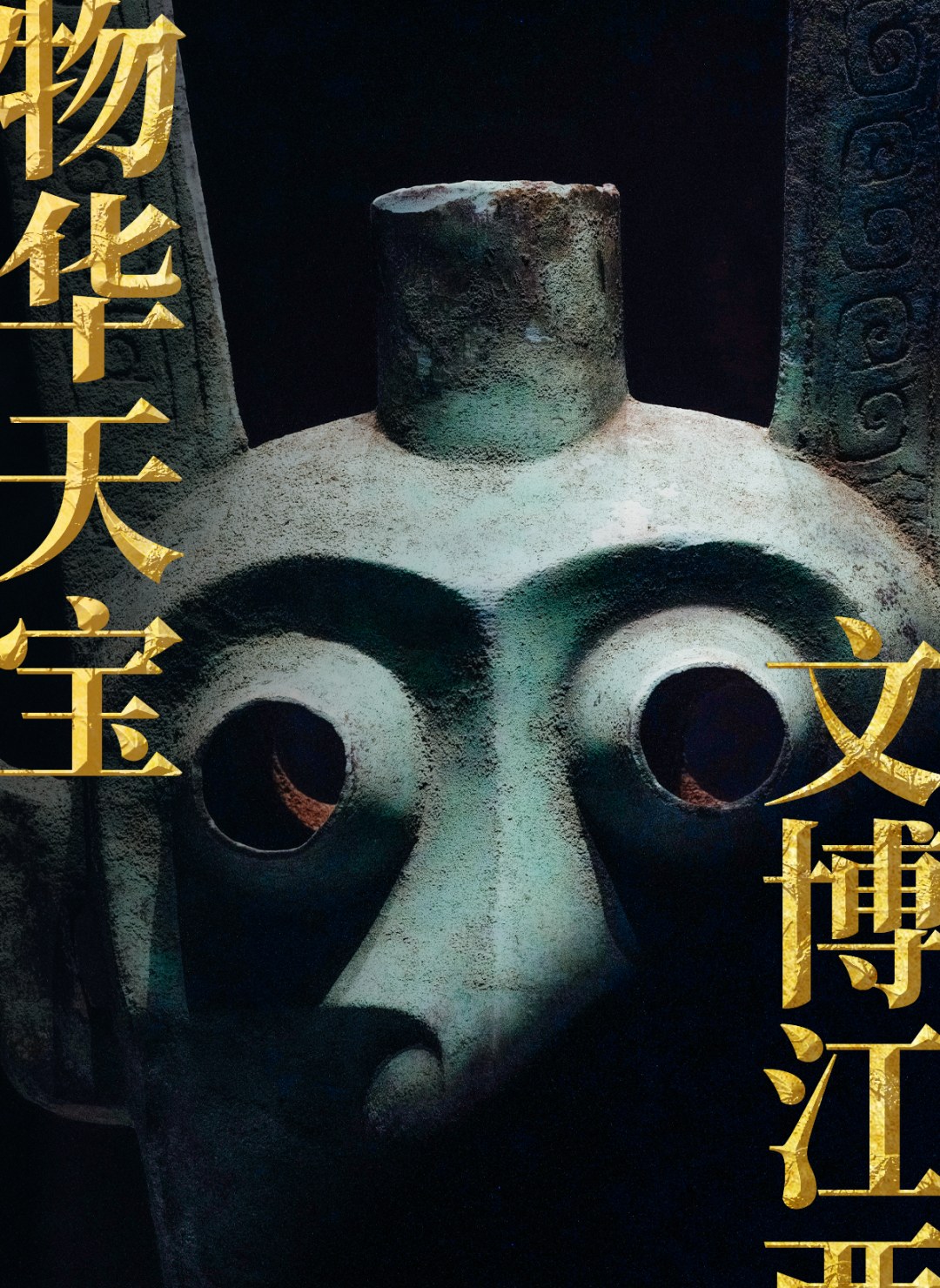
The Dayangzhou Shang tomb, along with the Fu Hao tomb at Yinxu and the Sanxingdui sacrificial pits, is considered one of the three major discoveries of Shang bronzeware. The style of the Dayangzhou artifacts seems to blend the standout features of the other two, incorporating bronze ritual vessels from the Central Plains, like ding and yan, while also showcasing the wild imagination of the south. The double-faced bronze human head looks like a replica of Sanxingdui’s bronze masks, except it couldn’t be worn—it was an idol for worshiping spirits, likely seen as a medium for communicating with the divine.
“An awkward but polite smile.”
The widespread tiger motifs and decorations on the unearthed bronzes offer clues to the tribe of the tomb’s owner: it may have been the “Hu Fang” (Tiger State) mentioned in oracle bone inscriptions as a target of King Wu Ding of Shang, maintaining a delicate love-hate relationship with the Shang dynasty. Among these bronzes, weapons dominate, suggesting the Hu Fang was a martial tribe. The Hu Fang people seemed especially fond of a type of bronze broadsword; the largest, a cicada-patterned broadsword, measures 67.9 centimeters long, with an upward-curving tip exuding a murderous aura. It was even chosen as the design inspiration for the Dragon Tooth Sword, the weapon of Dragon King Ao Guang in the film “Ne Zha: The Devil’s Birth.”
Top: The double-tailed, double-bird bronze tiger.
Bottom: The cicada-patterned bronze broadsword.
Photos by Zheng Jie and Liu Yedai.
With so many heavy bronze ritual objects buried with him, the tomb owner was certainly no ordinary figure. Six bronze yue axes indicate his high status; these ceremonial weapons symbolizing power resemble the character for “king” in oracle bone script, so the tomb owner was likely the king of the Hu Fang. Since the tombs of successive Shang kings at Yinxu were systematically destroyed by the Zhou, the Dayangzhou Shang tomb may well be the highest-ranking and best-preserved Shang tomb we can see—and it’s only found in Jiangxi.
How many Chinese cultural icons are in Jiangxi’s museums?
20,000 years ago, the ancestors at the Xianrendong site in Wannian, Jiangxi, lit the first fire for pottery, as if foretelling that Jiangxi was destined to become the “Eden” of ceramics.
Gazing at Jingdezhen’s Longzhu Pavilion through a gap in porcelain shards.
During the Yuan dynasty, Eastern and Western cultures merged in Jiangxi. Persian cobalt blue glaze met Jingdezhen’s kaolin clay, giving birth to blue-and-white porcelain. The classic blue-and-white color scheme, reminiscent of the blue sky and white clouds of the Yuan rulers’ homeland on the steppes, was highly favored, turning porcelain into a cultural icon that China exported worldwide for centuries and helping Jingdezhen earn its title as the “Porcelain Capital.”
Blue-and-white porcelain bowls produced in Jingdezhen.
Image by Visual China.
However, the intricate patterns of blue-and-white didn’t immediately replace the enduring popularity of monochrome celadon and white porcelain from the Tang and Song dynasties as the aesthetic mainstream. Limited by scarce raw materials, surviving Yuan blue-and-white pieces are extremely rare—only about 300 exist worldwide. In China, the museum with the largest collection of Yuan blue-and-white isn’t the Palace Museum or the National Museum of China; it’s the Gao’an Museum in a small Jiangxi county.
In 1980, a single hoard in Gao’an yielded 240 complete porcelain pieces, including 19 exquisite Yuan blue-and-white items. These porcelains were likely ritual vessels for the Yuan dynasty’s Ruizhou Prefecture government (modern-day Gao’an), hastily buried during the unrest at the end of the Yuan dynasty, becoming a “time capsule” spanning over 600 years until their discovery.
Yuan blue-and-white jar with cloud dragon and animal-mask ring handles, housed at the Gao’an Museum.
The Yuan artisans who invented blue-and-white porcelain weren’t content with just chasing vibrant colors. Beyond blue-and-white, they also created underglaze red, sky-blue glaze, and other richly hued porcelain types, leading a revolution in Chinese ceramic aesthetics. They even showboated by firing a Yuan blue-and-white with underglaze red granary, combining four glazes—blue-and-white, underglaze red, qingbai, and red glaze—in one piece. Each glaze required different kiln conditions, especially underglaze red, whose color development allowed only a 10°C temperature margin. These craftsmen, without precise temperature measurement, managed to fire all four glazes in a single
Firing such a piece showcases a masterful level of skill. This porcelain is also the only Jiangxi artifact selected for the first batch of prohibited items from being exhibited abroad, truly earning the title of Jiangxi’s top national treasure certified by the state.
The blue-and-white underglaze red stacked granary carries an epitaph on its back,
recording that the tomb owner, Lady Ling, died in the fourth year of the latter Zhizheng era of the Yuan Dynasty, which corresponds to 1338 AD.
Photography by Liu Yedao
However, if we visit Jingdezhen with a “treasure-hunting” attitude, we might face some disappointment. Ceramic artisans have long sold their finest products elsewhere, leaving behind a “mountain of ceramics” formed by tens of millions of broken porcelain pieces. According to the strict management rules of the imperial kilns in the Ming and Qing dynasties, even slightly flawed pieces had to be smashed on the spot to prevent them from leaking into the public. This “garbage heap,” looked down upon by nobles and officials, is considered a “mountain of treasure” in the eyes of ceramic researchers, because these shards hold the “DNA” of porcelain-making—such as the raw materials, formulas, and firing techniques of the time—making them essential specimens for studying porcelain craftsmanship.
Nowadays, most Jingdezhen porcelain is fired using industrial electric kilns,
but some still insist on using traditional wood-fired kilns.
Photography by Lanyu
Thus, the Jingdezhen Imperial Kiln Museum contains almost no complete exquisite porcelain. It is not an art gallery showcasing top-tier works but an archive tracing the history and manufacturing processes of ceramics, quietly telling us how porcelain became synonymous with China. Though Jingdezhen is no longer at its peak, it still attracts a large number of “Jing piao”—people passionate about handicrafts. As long as the kiln fires keep burning, the legacy of craftsmanship and culture continues.
If the page doesn’t load, please refresh and try again.
Jingdezhen is a place you can’t skip when discussing the history of Chinese porcelain.
Photography by Liu Yedao, Li Yishuang, Zang Ping, Hao Yu
Over the past 20,000 years, from the first kiln fires at the Xianren Cave, to the bronze flames at Dayangzhou, and then to the enduring cultural torch in the tomb of the Marquis of Haihun, the flame of Jiangxi’s civilization still shines today. Perhaps this is truly the only “Akaring Province” on the noisy internet, but every museum here bears the footprints of our civilization’s journey. Some places don’t need a sense of presence, because they genuinely exist.
Visit the Nanchang Han Dynasty Haihun Principality Museum,
to cure your trypophobia.
Photography by Qiu Fei’er
Text by Feitian Yimian
Edited by Ethan
Image Editor = G
Design by Zhang Qi
Cover Header image by Zheng Jie
Tag navigation
Explore articles that share the same tag and jump to tag pages.

Geografie zum Genießen: Wenn Chinas Landschaften als Tee und Kaffee im Glas landen
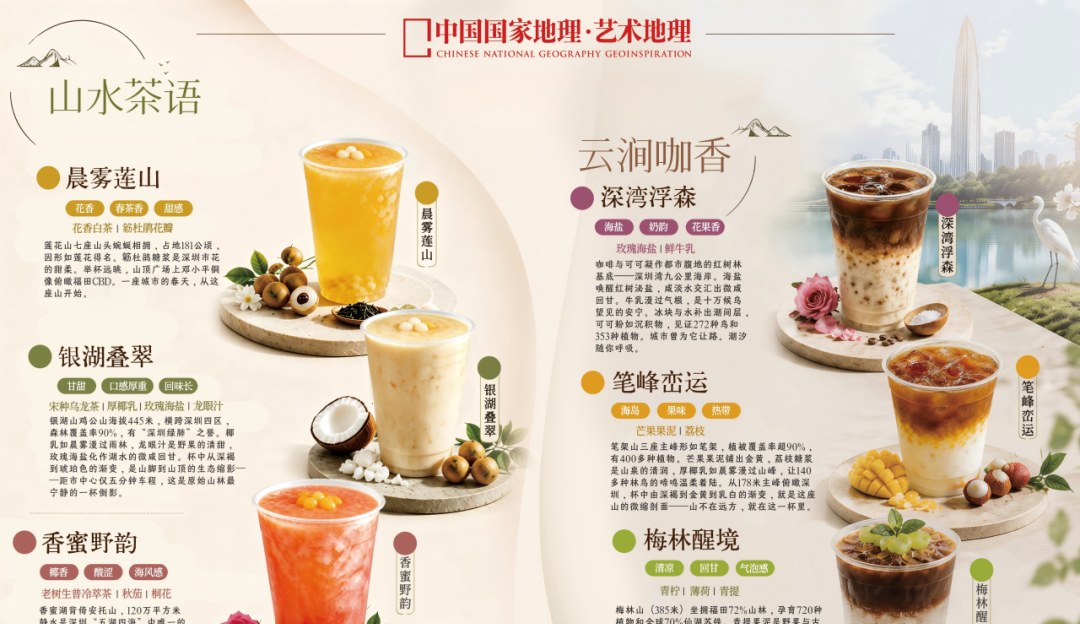
Geographieunterricht für die Geschmacksknospen | Wie lässt der „Berg-und-Fluss-Genuss-Mikroraum“ Berge und Flüsse schmecken?
Achtseitige Sonderbeilage der China Tourism News! Wenn die Schätze Shandongs zu einer langen Rolle der Qi- und Lu-Kultur werden
Category navigation
Jump to the article’s category or explore nearby topics.
In der Duft von Tee den schönsten Frühling Chinas erleben
Jump to the more recent article in this topic series.
Jeder Nordländer sollte diese südliche Götterfrucht einmal probieren
Continue to the previous article in this series.
Related stories
More articles from the same category and nearby topics.