Only when I walked out of Genie did I realize how heavy the word 'alive' is.
Read, share, and explore related stories through curated categories and tags.
Part 1 of 2.
In October 2025, I finally set foot on the long-awaited Genie Pasture trekking journey. Located deep in the Shaluli Mountains in Litang, Garze, Sichuan, the Genie Pasture is home to Mount Genie, the thirteenth goddess among the twenty-four sacred mountains in Tibetan Buddhism.
I’ve had quite a bit of trekking experience, but this was my first time tackling a long, high-altitude route with a heavy pack. I repeatedly scoured online guides, jotting down every piece of gear and supply I could think of in my notebook, and carefully anticipated the possible situations and weather changes over these days. Yet, the near-death experience still taught me the most unforgettable lesson of my life.
01
Loss of Light
Despair in the Dark, Wild Wind
The full route was about 62 kilometers long, with an average altitude of over 4,000 meters—a challenging trail. I planned to finish it in five days, and judging by my stamina and experience, I figured it would be no problem. Plus, guides showed that there were campsites every dozen or so kilometers for resupply and pitching tents.
After checking off everything on my list, I spread my gear on the floor and inspected it carefully. Staying warm was crucial—the temperatures in western Sichuan this season were brutally low, so I specifically chose clothing and a sleeping bag rated for extreme cold. For power, I packed a solar panel, several power banks, action camera batteries, two phones, and a watch that could last a week. For food, after precise calculations, I brought enough dry rations for a week.
Beyond that, I carefully checked the weather forecast for the route area. The data showed clear, cloudless skies for the past half-month, and the forecast for the coming week predicted bright sunshine. All this made me feel like the risks on the trail were manageable, so I was full of anticipation for the trip ahead.
I chose to go solo, harboring a bit of luck. Past trekking experience told me that on popular routes like this, there would be plenty of hikers and others camping at the sites—no real risk. But I never imagined that Genie’s best trekking season had already passed. On this desolate plateau, the cold and snow had already scared people off. The grazing season was over, and even the herders up in the mountains had descended back home. Only a few rickety wooden huts remained along the way, silently telling of people who had once been there.
On the shared ride to Genie, I met a boy from Changsha. He was also traveling solo with a heavy pack. After chatting, I found out he’d just graduated from college and was a few years younger than me, so I called him “little brother.” He’d seen online how beautiful this route was and just came. Looking back now, maybe it was because we were both inexperienced that we ended up in trouble later.
The little brother and I trekked together. Maybe due to the age gap, or because we were both reserved, we didn’t talk much. Along the way, we didn’t encounter anyone—all the campsites were deserted. At night, the plateau was eerily silent, with only the howling wind and endless darkness.
By the third day, the weight on my shoulders was nearing my limit. With every step, the pack felt heavier, crushing my breath—I had to focus entirely on my breathing just to bear the load.
By the fifth day, we were at 4,600 meters altitude. The steep climb that day left me struggling for breath. But knowing there was only a dozen or so kilometers left, and that if I pushed a little more, I’d be out of the mountains tomorrow, I found the motivation to keep going.
We planned to camp on a ridge at 4,600 meters, spending the last night in Genie. Under the faint moonlight, surrounded by peaks, I excitedly discussed with the little brother whether we’d see the golden sunrise on the mountains tomorrow. But neither of us expected that a life-or-death crisis was about to unfold…
The temperature kept dropping. I set down my heavy pack and pulled out my sleeping bag to set up camp. The moment I stood up, my headlamp suddenly went out. I was puzzled—I’d charged it when passing through a village earlier; there’s no way it should have died so fast. A malfunction? I casually asked the little brother to hand me a power bank. But the one he pulled out was also dead. How is that possible? It had been charged too.
Everything was pitch black, with a biting wind that left no shelter. The stunning scenery that had captivated me during the day turned into a terrifying hell in the dark. With my last bit of strength, I dragged my pack behind a large rock and fumbled through all my power sources, desperate to get some light and set up camp—anything to get through. But I was horrified to find that almost all my batteries were drained.
I called the little brother over. He had three 20,000mAh power banks and a low-temperature power source. I pinned my last hope on him, but whether due to high altitude or the cold, every battery had turned into a lifeless brick. Only my phone had a pathetic 30% charge left. In that moment, on that pitch-black plateau, the fear of having no light seeped into my bones.
The wind grew stronger, and we had to set up camp in the dark. By the faint moonlight, we laid out the ground mat, set up the inner tent, hammered in stakes, and tied the guy lines—each step exhausted me. I occasionally turned on my phone screen for a sliver of light to check positions but dared not use it too much—that 30% was our only hope to get out of the mountains tomorrow.
We finally got the tent up, crooked and slanted. I crawled into my sleeping bag, grateful I had one rated for extreme cold. I pinned my hopes on the solar panel: come daylight, if I could get just a little power to see the trail, I could walk out slowly even if it took time.
That night, in a state of utter exhaustion, I somehow slept for over ten hours in that dangerous environment. All night, I vaguely heard the wind battering the tent, but I couldn’t wake up—I kept sinking back into sleep. Was it fatigue? Altitude sickness? Or something else? This was the first time I’d experienced such complete loss of control. I knew in my mind it was dangerous, but I couldn’t stop the drowsiness. Thankfully, the night passed safely.
02
Snowstorm and Food Shortage
The Knocking at the Door That Night
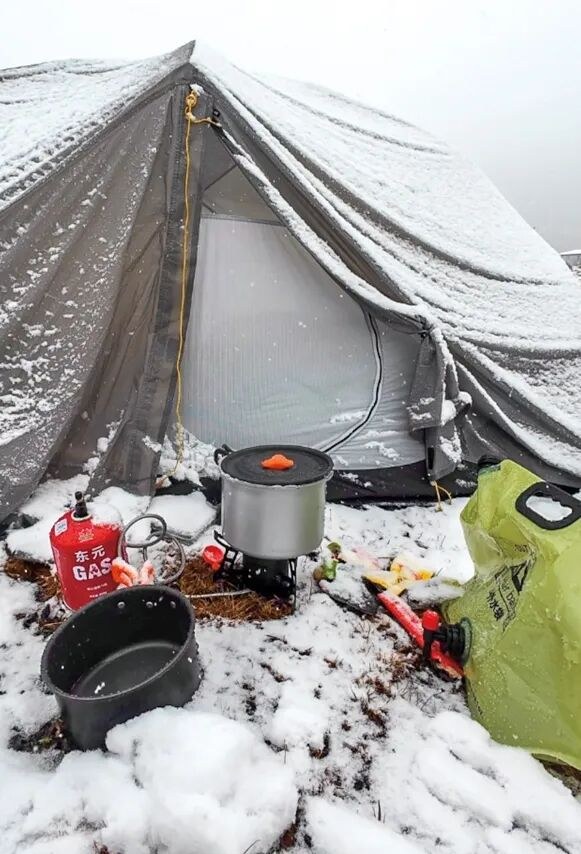
The next morning, I woke to sporadic dripping sounds outside the tent. With a sinking feeling, I slowly unzipped it, and my heart dropped.
It was over.
As far as I could see, everything was white. A heavy snow had fallen all night, completely covering the path we’d come from. Thick fog reduced visibility to less than five meters. From my limited trekking experience, I knew the scariest thing at high altitudes is heavy fog—I panicked. The clouds were thick and low, with no sign of dissipating. The dripping patter on the tent hit my frayed nerves with every drop.
Staring at the apocalyptic, gray scene outside, I froze for a while before pulling out my phone and turning it on. Last night, to save power, I’d deliberately shut it down and kept it warm in my sleeping bag. The screen showed just over 20% battery—our only hope. As expected, there was no signal. I quickly turned it off, not daring to waste a single percent.
I tried to steady myself and analyzed the situation: We couldn’t go on—without power to see the trail, wandering in this weather was a death sentence. The solar panel was useless now. We had to wait for the snow to stop, charge up, and then go. But would the snow stop? When? If it didn’t, what then? Just wait here indefinitely?
After racking my brain with no answers, I decided to eat something to regain strength. Luckily, there was a water source near our camp, but the stove’s flame was too weak at high altitude, and the water boiled agonizingly slow—it took ages before we had a sip of hot water.
Opening my supply bag, my heart sank again—three bread rolls, a few quail eggs, some chocolate, and half a bottle of Coke. That was all my food. The little brother had some noodles and rice, but they were hard to cook in this environment. We pooled our food and calculated how long it would last. As we did, both of us fell silent—we had way too little.
By midday of the second day trapped, the snow was falling harder, the temperature dropping, and we couldn’t move at all. A heavy gloom hung over us. That whole day, we each huddled in the tent, barely speaking.
I’d never felt “a day feels like a year” so clearly. On this stormy, snowy plateau, I felt utterly insignificant for the first time—life and death seemed to hinge on nature’s whim. I feared the blizzard would throw me off a cliff, that the cold would freeze me to death, that I’d get lost and even rescue teams couldn’t find me. What terrified me more was that I hadn’t told anyone about this trip—my parents were against my outdoor adventures, and only one fellow hiker knew my route. So, for now, no one would come rescue me.
All day, I could only listen to the snow hitting the tent, passing the time in anxiety.
In the afternoon, the sky took on an unusual gray tone, the fog thickened, and the clouds pressed almost to the ridge. I checked my phone—it was only 2 PM, but it felt like dusk, a clear sign of extreme weather. I called out to the little brother; he answered after a long pause, saying he’d just dozed off again. Thankfully, he had no altitude sickness—otherwise, in these conditions, it would have been fatal. “The weather’s not right. We can’t stay here,” I suggested we take shelter in the herder’s hut we’d passed last night. “You wait here; I’ll go check it out first.”
I put on all my warm layers and stepped out of the tent. The moment I had my boots on, breathing became a struggle. After a night in the cold at 4,600 meters, with depleted energy and little food, my body was barely holding up. I trudged toward the hut, the crunch of snow underfoot sounding harsh. Luckily, the hut’s door was unlocked, and we could take shelter. After packing everything, including the tent, the little brother and I each took a corner of the tent and stumbled over to the hut.
We went in.
Part 2 of 2.
He glanced around the wooden cabin—it was probably a temporary shelter for Tibetan herders during the grazing season. Inside, there was a simple stove, and scattered on the floor were some bowls, chopsticks, and basic clothing. I told my brother to settle in while I went to look for usable supplies. Lucky for us, I found some dry firewood. We had a lighter, so now we could stay out of the wind and keep warm. Unfortunately, we had no idea how to use the stove in this area. After starting the fire, the cabin filled with thick smoke that stung our eyes so badly we could barely keep them open. After struggling for a while, it was already pitch dark outside, and the cabin was completely black.
“Let’s sleep,” my brother said in low spirits, curling up on the other side of the stove.
He shut the cabin door, but I got up and opened it again. “We can’t close the door. The place is full of smoke. If we sleep like this, we’ll definitely get carbon monoxide poisoning.”
“What poisoning? You’ve watched too many dramas!” he snapped, getting worked up. “If we don’t shut the door, we’ll freeze to death here!”
I was surprised by his sudden outburst. Looking back, I realize his state of mind was off. He got up and closed the door again. “Keep it shut. I’m cold.”
I argued back firmly, “No, listen to me. With all this smoke in here, something will happen if we fall asleep.” I opened the door once more.
This time, neither of us spoke. A heavy silence settled between us as we curled up in our sleeping bags, drifting off in a daze. After a while, it seemed the smoke had cleared, so I got up and closed the rickety iron door.
I don’t know how much time passed, but hunger had gnawed at me for so long that I woke up to a sharp cramp in my stomach. Clutching my belly, I curled deeper into my sleeping bag, groggily reached for my last mouthful of cola, and drank it. The pain eased gradually, and I drifted back to sleep.
In the haze, a rhythmic tapping sound came through—tap, tap, tap. I jolted awake: This wasn’t a dream! The sound was knocking on the cabin door. Instantly, my hair stood on end, and cold sweat drenched me! I practically sprang upright, my heart pounding.
“Brother, are you awake? What’s that sound?” I asked.
“Yeah, I’ve been awake. It’s been knocking for a while,” he whispered back.
Neither of us dared to go check. Was it the wind? Could the wind produce such a rhythm? Was it a person? Out here in the middle of nowhere, who would be around at midnight? Was it a bear? I’d heard there were bears and wolves roaming these parts… Fear consumed everything. I forgot the pain, the hunger—only one thought remained: Am I going to die here?
“Should we check it out together?” I said.
“Don’t make a sound. Let’s just stay put,” he answered cautiously.
I knew he was on the verge of breaking down too. Scared out of my wits, I buried my head in my sleeping bag, even though it was suffocating. Gradually, the tapping faded and eventually stopped.
But I couldn’t sleep anymore. I pulled out my phone; the battery was below 20%, and there was no signal—it was as useful as a brick. I stopped conserving power and opened the notes app. I briefly wrote down what had happened, then added a lot of things I wanted to say to Mom and Dad, along with all the regrets I had in life. If I was going to rest here forever, I figured this note could serve as my “last words.”
But in the end, I deleted everything. I wanted to live.
And so, I spent the night in despair and torment until the sky slowly brightened.
03
A Turning Point Between Life and Death
Burning Bridges and Surviving in the Genie Mountains
On the third day of being trapped, when the first light crept through the small window of the cabin, I got up to discuss our next steps with my brother.
I’d thought all night and decided we couldn’t just sit and wait. Stuck here, our supplies would run out, our strength would fail, and the weather would only get worse—it was as good as waiting to die. Last night’s ordeal had pushed me to the brink. This time of year, no herders would come up the mountain. Waiting for rescue? That was even less realistic; no one even knew we were here.
I suggested retreating to the previous camp 12 kilometers away. It was at a lower altitude, and there were herders and tourists nearby—if we could make it there, we’d be safe.
My brother reacted fiercely: “Are you kidding me! Go back? Look at the trails—they’re all buried under snow! We don’t have tracks! No power! Getting lost would be suicide!”
“But what’s the difference between staying here and waiting to die? We barely have enough food left. Look at the clouds—if we don’t leave now, a blizzard is going to hit us hard.”
“No, we can’t go. Dying here is better than dying halfway!”
We had the worst argument of our entire trip, neither willing to back down.
After the argument, I stepped outside the cabin to cool off. I realized my own state wasn’t right either. We were partners in life and death; our priority should be unity. I calmed down, went back inside, and apologized. I admitted we both had valid points, but retreat was our only hope.
We finally settled down, talked it through seriously, and decided to head back.
We made a plan together: I’d lead the way, and he’d double-check from behind. If we veered off course, we’d decide together to stay safe. We’d mark our trail as we went, and if worst came to worst, we could follow the marks back to the cabin and wait for rescue.
To lighten our load, we only packed the essentials and set off. Before leaving, I left a hundred-yuan note on the stove to thank the herder for letting us stay. I closed the door and bowed three times deeply to the cabin, grateful that it had given us a lifesaving shelter in our most helpless and dangerous moment.
The path back was covered in knee-deep snow, and every step was a struggle. Luckily, the snow didn’t get heavier, and the way down was fairly clear. Driven by a strong will to survive, I pushed forward nonstop without a break. As we descended, the wind and snow gradually eased. It turned out the whole world wasn’t as apocalyptic as it seemed—only the extreme weather at high altitudes was that dangerous. As I walked, when I saw the village a few kilometers ahead, my tense nerves finally relaxed, and I collapsed onto the grass.
I was alive.
In that moment, there was no wild joy, just an immense calm washing over me. I wanted to cry, not from fear or sadness, but from a certainty—a certainty that I was still connected to this world.
I got up and kept going. For those last few kilometers, my body was on the verge of collapse, but my steps grew lighter. When I finally approached the village, saw the houses, cars, and herders, I looked back at the snow mountain that had nearly swallowed me whole. It stood there, solemn and peaceful, as if nothing had happened.
We were lucky. As soon as we reached the village, we ran into two guys on a road trip from Yunnan. I swallowed my pride and flagged them down for help.
On the way back to town, a terrifying blizzard hit the plateau. At over 4,000 meters above sea level, heavy snow came down thick, making visibility nearly zero. If we’d stayed on the mountain, we would have died for sure. In the car, my brother and I couldn’t help feeling relieved: This sense of survival was truly sweet.
The road ahead was still long and full of unknowns. But I’ll never forget what happened here. The impact of that storm didn’t end when I walked out of those mountains—it’s forever etched into the fabric of my life.
—THE END—
Writer: He Xi
Photos: He Xi, Wu Hua, Mysterious Guest
Deng Wei, Chen Haobo, Gaotianshangliuyun723
Layout: Kawaguchi’s Kid
“Global Human Geography” May 2026 Issue
▼
▼
Click the image below
▼
Subscribe to “Global Human Geography”
Tag navigation
Explore articles that share the same tag and jump to tag pages.

Geografie zum Genießen: Wenn Chinas Landschaften als Tee und Kaffee im Glas landen

Geographieunterricht für die Geschmacksknospen | Wie lässt der „Berg-und-Fluss-Genuss-Mikroraum“ Berge und Flüsse schmecken?
Achtseitige Sonderbeilage der China Tourism News! Wenn die Schätze Shandongs zu einer langen Rolle der Qi- und Lu-Kultur werden
Category navigation
Jump to the article’s category or explore nearby topics.
Die erste Litschi des Jahres muss diese sein
Jump to the more recent article in this topic series.
【Hinweis】 Mitte Mai sinken die Preise für Haupt- und Nebennahrungsmittel in unserer Stadt stabil
Continue to the previous article in this series.
Related stories
More articles from the same category and nearby topics.