Domestic and international cases illustrate how historic districts can be rejuvenated
Read, share, and explore related stories through curated categories and tags.
Guided Reading: Currently, when it comes to cultural resources in historic districts, the focus is not only on heritage protection but also on their contemporary recognition and development potential. Based on dynamic cultural resource protection, this article proposes three approaches to revitalizing the cultural vitality of historic districts: combining industrial renewal with cultural characteristics, organizing multi-stakeholder cultural activities, and using cultural symbols in spatial environments. These are accompanied by case studies to provide references for regenerating cultural vitality in historic districts.
I. Introduction
Today, culture increasingly serves as a leading force in economic and social development. In the new economic era, key resources for urban competitiveness have shifted from traditional tangible assets in the industrial age to “soft power” like culture, talent, and knowledge innovation. Therefore, an important aspect of urban competition can be seen as cultural competition. Cities worldwide with fresh ideas and unique cultures hold a competitive edge due to these hard-to-imitate strategic resources.
Historic districts are areas rich in cultural relics and historic buildings, accurately reflecting traditional styles or ethnic local characteristics from certain historical periods. They are cultural hubs, showcasing a city’s unique “local identity” and enhancing its competitive advantage. However, these districts often suffer from physical decay and functional decline. Under the dual pressures of Western cultural influence and large-scale modern urban construction, they face issues like the disappearance of cultural carriers, difficulties in cultural heritage preservation, and decreasing cultural recognition, leading to cultural stagnation, decline, or even extinction.
Given culture’s immense comprehensive value in the new era, cultural resources in historic districts are increasingly valued. Contemporary approaches to handling, protecting, and rationally utilizing old city cultural resources have broken away from traditional mindsets. They no longer focus solely on heritage protection but emphasize contemporary recognition and development potential. They don’t just look at static preservation but prioritize the use and re-creation of cultural resources. Also, they don’t view cultural resources as passive subjects of protection; instead, they believe culture can drive tertiary sectors like creative industries and leisure tourism, revitalizing them in the new era.
II. Three Approaches to Revitalizing Cultural Vitality in Historic Districts and Case Studies
1. Approach One: Combining Cultural Characteristics with Industrial Renewal
In the 1970s, Western countries entered the twilight of industrialization, with cities shifting from production to consumption, and local development potential turning toward culture and the arts. Since then, cultural industries have gradually become new global economic growth points. Over the past two decades, cultural capital helped some declining old city areas in developed countries reposition and revive in the post-industrial new economy. Using culture to drive tertiary sectors like creative industries and leisure tourism has become a widely adopted core strategy in historic district renewal.
By thoroughly studying local historical and cultural resources and building on culturally related industries that have already formed agglomeration advantages, guidance can be provided toward cultural tourism, creative industries, and leisure culture. This creates culturally functional service areas with unique local flavor and resource endowments, promoting the regeneration of local cultural vitality.
Case: Kuanzhai Alley in Chengdu
Chengdu is one of China’s first 24 historic and cultural cities, serving as the political, cultural, economic, and tourism hub of the southwest. The Kuanzhai Alley historic and cultural protection area, bounded by Wutongshu Street, Jinhe Road, Changshun Shang Street, and Xia Tongren Road, focuses on three traditional alleys: Kuan Alley, Zhai Alley, and Jing Alley. In 2003, the main renovation project of the area was established. The goal was to protect the original architecture of old Chengdu while forming a composite cultural commercial street focused on tourism and leisure, with strong regional characteristics and a rich Bashu cultural atmosphere. It was eventually developed into “Tianfu Shaocheng,” embodying the essence of “Old Chengdu’s negative, New City’s living room.”
Each alley has its own theme: Zhai Alley represents old Chengdu’s “slow life,” Jing Alley stands for Chengdu people’s “new life,” and Kuan Alley embodies old Chengdu’s “leisure life.” The commercial formats in each alley vary but are all integrated with local life culture, accepted by tourists and consumers of all ages, while effectively promoting and preserving local culture, creating a vibrant and lively atmosphere.
In Chengdu’s Kuanzhai Alley renewal, cultural resources, carriers, and industrial development complemented and promoted each other, achieving a “three-in-one” integration: cultural spirit, form, and business model. “Cultural spirit” refers to the heritage’s cultural and spiritual essence; “form” refers to physical manifestations like buildings and artifacts that constitute the landscape; “business model” means creatively arranging and developing consumer formats based on modern consumption needs. This approach allows cultural spirit and form to carry the soul and overall landscape of the cultural heritage, while the business model embeds modern consumption experiences into traditional Chengdu leisure culture.
Case: Temple Bar District in Dublin, Ireland
Dublin’s Temple Bar District is located in the city center, surrounded by numerous historical and cultural sites. The area retains many old buildings, dating back to the mid-18th century. It preserves a medieval streetscape with narrow cobblestone streets and varied architectural styles on both sides. Old and new coexist harmoniously in the district, with cultural institutions, art workshops, museums, cinemas, hotels, bars, restaurants, and residences organized seamlessly. Both residents and tourists can find what they need and relax comfortably.
The successful transformation of Dublin’s Temple Bar District lies in its respect for culture and emphasis on local characteristics. What makes it special is that it’s more of a cultural district than a purely tourist area. Its tourism potential mainly stems from a strong sense of artistry and creativity, with many small cultural activities shaping the district’s local character.
The Temple Bar District experienced cycles of prosperity, decline, and revitalization. The revitalization began with small businesses like record stores, art workshops, second-hand shops, rehearsal rooms, cafes, and restaurants appearing in old buildings, attracting more artists, musicians, and merchants. The district gradually developed a strong bohemian vibe, which drew government attention to the old district’s value. This process shows that culturally rich artistic industries with local flavors are vibrant. The formation and development of one business format often drive the emergence and growth of related formats, eventually forming a certain industrial structure while further strengthening and enlivening local culture.
2. Approach Two: Multi-Stakeholder Participation in Cultural Activities and Festivals
In past historic district renewals in China, the government was often the primary implementer. However, without spontaneous resident participation, results like “beautiful streets but few people” were not uncommon. Public participation is crucial for revitalizing local cultural vitality because strengthening local residents’ cultural identity builds local cultural confidence, ensuring that distinctive local cultural vitality is sustained long-term.
At the same time, cultural construction requires effective cooperation between planning and cultural departments, as well as active participation from third-party non-profit organizations like art groups and associations, to achieve cultural prosperity and diversity. Only through multi-stakeholder cooperation mechanisms can cultural resources be maximized. Therefore, involving diverse participants, including community residents, is an important approach to regenerating local cultural vitality.
Case: Baoan Temple Historic Area in Taipei
Baoan Temple, commonly known as Dalongdong Baosheng Temple, is located on Hami Street in Taipei’s Datong District. It is dedicated to Baosheng Dadi, a Taoist deity, and serves as the religious center of the Dalongdong area. The Baoan Temple area is one of Taipei’s early development hubs and a region rich in historical and cultural resources. Besides tangible cultural resources, it includes intangible assets like Baoan Temple and Confucius Temple celebrations, folk beliefs, and local historical events, with the annual Baosheng Cultural Festival being the most distinctive.
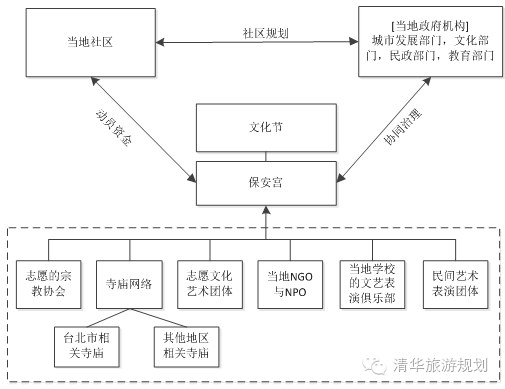
Community participation in the Baoan Temple area’s regeneration connects four types of actors and networks, each playing different roles in the Baosheng Cultural Festival: 1) Participation in procession activities: involving the folk art network managed by Baoan Temple, including traditional art and sacrificial groups, local folk music bands, related local temples, and voluntary art and religious organizations; 2) Participation in family opera performances: Baoan Temple invites professional and amateur traditional opera troupes from Taiwan, as well as regional school art clubs; 3) Participation in urban marketing activities: the Taipei City Government mobilizes administrative agencies, including the Urban Development Bureau, Department of Cultural Affairs, Department of Civil Affairs, and Datong District Office, to jointly plan the festival, and produces advertisements for print and electronic media promotion; 4) Participation of local community professionals and volunteer organizations: providing opportunities for community residents to showcase themselves, involving traditional cultural activities (e.g., Nanguan orchestras, Taiwanese opera) and community cultural education services (e.g., Baoan Temple history explanations, health education lectures, library setup). Community residents are the main source of volunteer organizations.
The cooperation between the local government and local community groups led the Baoan Temple regeneration project. The local government shifted from traditional hierarchical management to a collaborative governance model, coordinating three relationships: temple-community-government. All three played crucial roles in cultural mobilization and environmental improvement (see Figure 1). The local government, together with the other two, adopted a new “collaborative governance” approach.
“Community-based cultural planning” and the mobilization of public resources, such as media and the tourism industry, work together to enhance the image of Bao’an Temple and the influence of its cultural festival.
Bao’an Temple’s heritage preservation strategy won the UNESCO Asia-Pacific Heritage Award in 2003. UNESCO noted that the success of Bao’an Temple’s regeneration stems from leveraging public participation to bring out the value of its intangible cultural heritage.
Figure 1: Public Participation Network at Taipei Bao’an Temple Cultural Festival
3. Pathway 3: Application of Cultural Symbols in Spatial Environments
The spatial environment of a historic district serves as the backdrop for local culture. Any modern renovation or construction cannot ignore the scale, street layout, colors, and other elements of the historic district.
Cultural symbols are a condensed expression of cultural characteristics and can reinforce the cultural image of historic districts. In the renovation and enhancement of the landscape environment of historic districts, elements from classical architecture, philosophy, aesthetics, and spirituality can be referenced to design cultural symbols that combine cultural significance with contemporary relevance. These symbols can be appropriately applied to structures such as buildings, street furniture, and advertising signs. Street furniture like flower beds, benches, and trash bins should be specially designed to match the historic character, with some spaces slightly enlarged to feature cultural landscape installations.
Case Study: Dongzhimen Inner Street (Gui Street) in Beijing
Dongzhimen Inner Street (referred to as “Dongnei Street”), also known as “Gui Street,” is an important commercial street in Beijing. It originated during the Yuan Dynasty and thrived during the Ming and Qing dynasties with bustling temple fairs and commerce. Before environmental renovation, Gui Street was renowned as the city’s top night market, but it faced challenges in sanitation, landscape quality, spatial order, and public safety. The lack of environmental awareness among merchants led to conflicts in the district’s development.
During the environmental landscape upgrade, studies and discussions were conducted on topics such as “Refining and Integrating Contemporary Commercial Elements of Gui Street,” “Refining and Integrating Historical and Cultural Resources of Gui Street,” and “Juxtaposing and Integrating Contemporary Commercial Elements with Historical and Cultural Resources of Gui Street.” Plans and designs were made for architectural style, street environment, and advertising signs.
In terms of sculptures, items related to “gui” (ancient ritual vessels) were used to enhance the street’s historical feel. For lighting, classical lamps and ground lights were emphasized to complement the historical ambiance of the sculptures and green landscape designs, thereby strengthening the cultural atmosphere of the street. Particularly in the design and placement of advertisements and signs, efforts were made to explore historical and cultural connotations. First, the Gui Street logo was designed to condense and express the overall image of the street. Second, landmarks were created, replacing the bronze “jue” vessel originally located west of the Dongzhimen overpass with a bronze “bo gui” vessel to highlight Gui Street’s presence, direction, and identity. Third, directional signs were designed, incorporating the commercial elements and spatial features of Gui Street to create vivid spatial maps that guide foot traffic and enrich the landscape.
III. Conclusion
A city is not just a physical space made up of buildings; it is also a carrier of the spirit and culture of its residents. Most cities in China have a long history, and their historic districts, in particular, hold cultural relics and environments that are invaluable urban resources with high comprehensive value. A historic district or city that loses its regional cultural characteristics loses its charm and value.
Over the past 30 years, with globalization and the invasion of Western culture, cultural assimilation has spread worldwide, significantly impacting local cultures. At the same time, the progression of the times is irreversible, and people’s production and lifestyles are constantly changing. We must recognize that historic districts and their cultures belong not only to the past but also to the present. A balance should be found to preserve traditional culture as much as possible without hindering urban functional adjustments and development, allowing both to coexist harmoniously.
In contemporary times, urban culture is not just about the character and lifestyle of specific places; it has become a core component of urban competitiveness. This shift in cultural productivity brought by the times offers new ideas and opportunities for the revitalization and regeneration of historic district cultures.
Based on the dynamic preservation of cultural resources, this article proposes three approaches to revitalizing cultural vitality: first, developing cultural and creative industries, cultural leisure industries, and cultural tourism related to local cultural characteristics; second, promoting public participation and actively encouraging diverse entities to engage in cultural activities and festivals, embedding the regeneration of cultural vitality deeply into the community; third, applying cultural symbols representing local characteristics to architecture and the environment, strengthening the local cultural image in physical spaces and creating a cultural atmosphere in historic districts.
The regeneration of cultural vitality in historic districts is essential for preserving traditional culture and building a city’s cultural appeal. The three approaches proposed in this article aim to retain, activate, and rejuvenate the cultural characteristics of historic districts, meeting the needs of economic development and people’s livelihoods while also considering cultural experiences, continuing historical context, highlighting urban cultural features, and leveraging cultural advantages in the urbanization process.
Tag navigation
Explore articles that share the same tag and jump to tag pages.
Chinesische Gärten · Leitfaden für neue Ausgaben | Landschaftsarchitektur – Wissenschaft und Kunst der Verwaltung und Gestaltung von Oberflächenräumen (Volltext herunterladbar)
In- und ausländische Fallbeispiele zur Wiederbelebung historischer Viertel
Chinesische Gartenbau · Brancheninformationen | 2024 Bildungsministeriumskonferenz des Ausschusses für Landschaftsarchitektur und 9. Forum für nachhaltige Landschaftswissenschaften erfolgreich in Nanjing abgehalten
Category navigation
Jump to the article’s category or explore nearby topics.
15 alte chinesische Straßen: In der Atmosphäre des Marktes liegt der Geschmack der Heimat
Jump to the more recent article in this topic series.
Das großartige China: Historische Viertel! Die Qilou-Alte Straße in Haikou im CCTV-Fokus
Continue to the previous article in this series.
Related stories
More articles from the same category and nearby topics.