China's World Heritage: A Rare and Irreplaceable Wealth
Read, share, and explore related stories through curated categories and tags.
Click the blue text above to follow “China National Geographic”
Today, June 12, 2021
is not only the first day of the Dragon Boat Festival holiday
but also the second Saturday of June
which is China’s “Cultural and Natural Heritage Day”
China boasts a wide variety of world heritage sites
China ranks first globally in the number of world natural heritage sites
and is also one of the countries with the most
world cultural and natural mixed heritage sites
Five thousand years of Chinese civilization
stretching across thousands of miles of rivers and mountains
these invaluable world-class heritages
are right beside usBeijing’s Forbidden City
Inscribed as a World Cultural Heritage Site in 1987
A thousand people see a thousand different Forbidden Cities
For hurried tourists who only skim the surface
What draws them is often the palace’s
lavish luxury and all kinds of mysterious tales
But historians tend to focus
on examining Ming and Qing court politics
and interpreting traditional Chinese culture
For the research experts who live deep inside the Forbidden City
What they love to talk about
is the evolution of Chinese palace architecture
and the systems of artifacts and rituals under the Ming and Qing dynasties
…
Mr. Shan Shiyuan, a specialist in Ming and Qing history, once said
“The Forbidden City is a complete history of China, not just an imperial palace.”
This shows how the Forbidden City and its rare treasures
hold immeasurable value in cultural traditions and historical information.
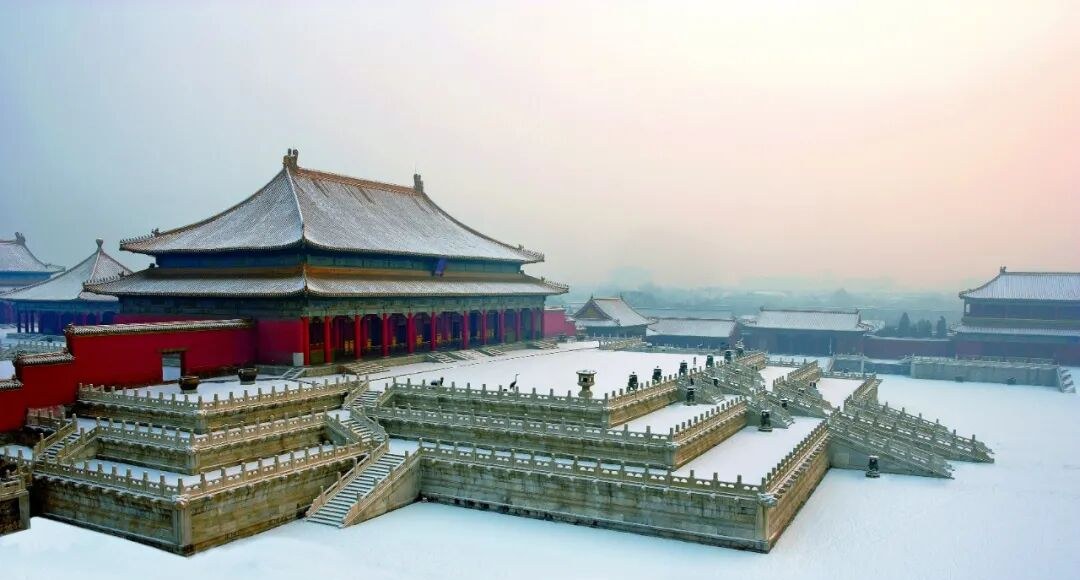
◎ White Marble High Platform
Heading north along the central axis of the Forbidden City, past the dragon-carved stone imperial path, the Hall of Supreme Harmony, elevated on a white marble terrace, appears especially grand and majestic. The terrace is made up of three superimposed Sumeru thrones, commonly known as the “Three Platforms.” According to ritual protocol, when the emperor received congratulations in the Hall of Supreme Harmony, civil and military officials had to stand in order of their ranks and perform the three kneelings and nine prostrations facing the imperial throne. Generally, only princes, dukes, and ministers were qualified to stand on the Three Platforms; other officials could only stand in the courtyard, while lower-ranking minor officials had to imagine the emperor’s countenance from outside the Gate of Supreme Harmony. (Listed as a World Cultural Heritage in 1997/2000
Creating a universe within a tiny space
Suzhou gardens stand as masterpieces of Eastern garden art
vastly different from traditional Western gardens
As architect Tong Jun once said:
The Chinese character for “garden” (園) in its traditional form
the outer “口” represents the enclosing walls
“土” resembles a building’s floor plan, hinting at pavilions and terraces
the central “口” symbolizes a pond
while the remaining strokes evoke rocks and trees
This is the perspective of a refined scholar, rich with aesthetic beauty
The owners of Suzhou gardens pursued a transcendent way of life
cherishing simplicity, serenity, and understated elegance over luxury
Buildings and waterscapes are nestled among lush greenery
The colors, fragrances, forms, and sounds of plants
can form independent scenes
or be woven into other landscape elements:
locust trees shading the courtyard, willows lining the banks, plum trees encircling the hut, bamboo groves sheltering the thatched cottage
creating a poetic environment
a perfect blend of life as art and art as life
reflecting the ancients’ deep concern for life and its quality
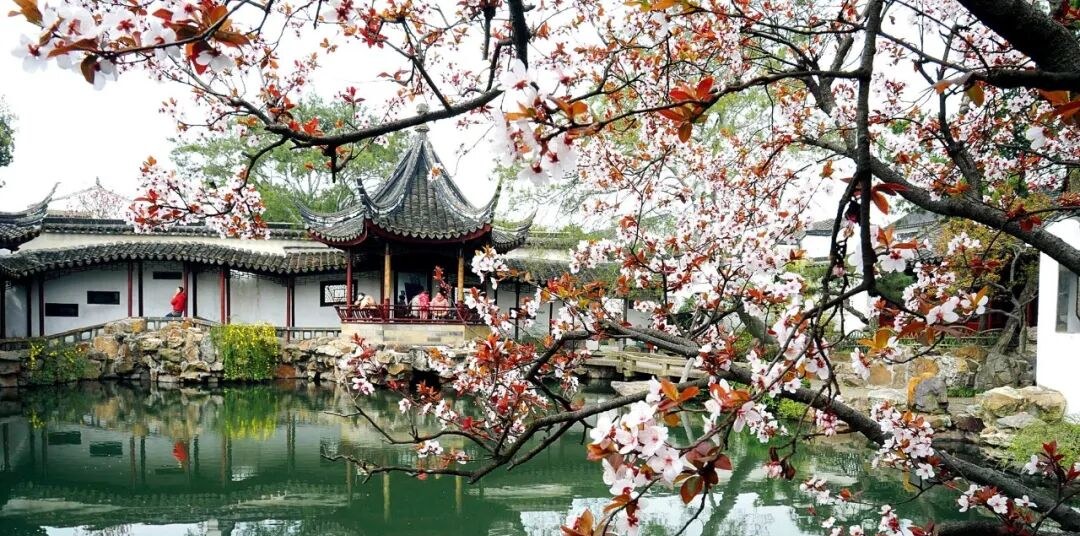
◎ Master-of-Nets Garden
Every time I visit a garden in Jiangnan, the phrase “the literary mind and the carving of dragons” comes to mind, because they are so small yet so exquisite. Take the Master-of-Nets Garden, for instance—it covers only nine mu, with its main features being a lotus pond and a yellowstone rockery, complemented by some ancient trees and a few pavilions and corridors. What’s fascinating is that it seems endlessly deep: winding corridors lead to the Small Hill and Osmanthus Fragrance Pavilion, hidden among green trees and rocks. Looking north through a lattice window, you see a yellowstone rockery that isn’t tall but boasts a rugged grandeur, as if nature itself had shaped it. Following the “Woodcutter’s Wind Path” along the hillside, turning west and then north, you’ll reach the Splash and Tassel Water Pavilion. Climbing up, the view suddenly opens up to a shimmering clear lake, reflecting the bright scenery all around. (Image from Chinese National Geography, May 2014)South China Karst
Inscribed as a World Natural Heritage Site in 2007/2014
“Karst” was originally the name of a limestone plateau on the Istrian Peninsula, where typical karst landforms developed. Thus, “karst” became a general term for such landscapes. However, in comparison, southern China is far more qualified to be the “spokesperson” for karst landforms.
China has the largest area of karst landscapes in the world. From tropical to cold-temperate zones, from humid to arid regions, all types of karst landforms are present in great variety. China is also the earliest country to document and study karst landforms. As early as the Jin Dynasty, there were records of karst topography, with the most detailed accounts found in Xu Xiake’s Travel Diaries from the Ming Dynasty.
From research history to distribution area, China is truly a “Kingdom of Karst.” With so many breathtaking sights—peaks, forests, mountains, valleys, lakes, rocks, waterfalls, springs, and ponds—karst landforms encompass almost all natural landscape elements.
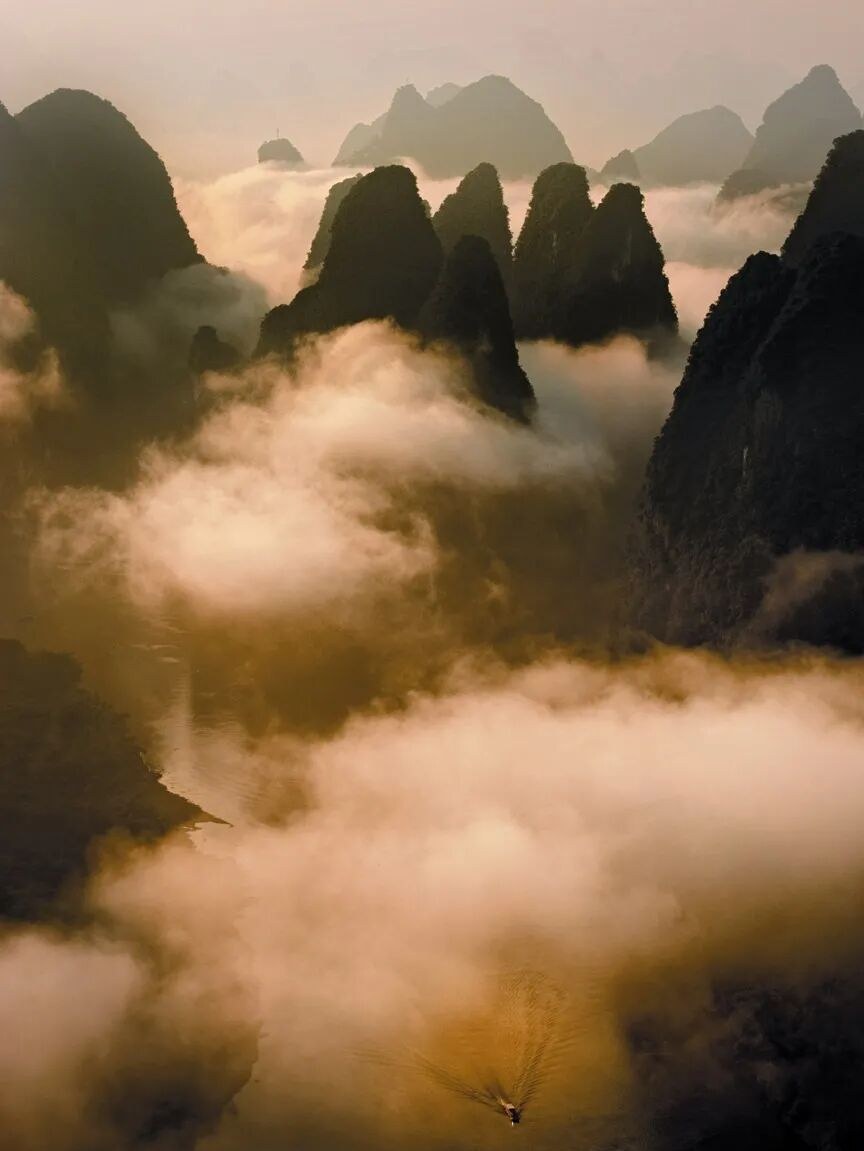
◎ Misty Li River
Mist and sunlight blend into a thick or thin white fog, drifting among the mountains; peaks and peak clusters intertwine and nestle together as the Li River meanders. The river scenery between Elephant Trunk Hill in Guilin and Bilian Gorge in Yangshuo is the most beautiful stretch of the Li River. Drifting downstream, the dark green stone mountains and the unhurried, gentle flow of water showcase the most quintessentially Chinese Guilin-style karst landscape. ( Inscribed on the World Natural Heritage List in 2010
Danxia landform
A landform entirely discovered and named by Chinese scholars
Since its birth, it has been deeply marked with a “Chinese imprint”
They are a group of upright, steep cliffs
With red rocks exposed on the cliff faces
The layers of rock, along with textures formed by years of sun, wind, and water erosion
Are exposed to the air
Like a painting on the earth
China not only boasts vast and diverse Danxia resources
But even its name comes from an ancient Chinese poem
These beautiful red mountains
Like a glow of morning or evening light descending upon the earth
Have brushed a layer of color onto Chinese civilization—
“Red as cinnabar, brilliant as rosy clouds”
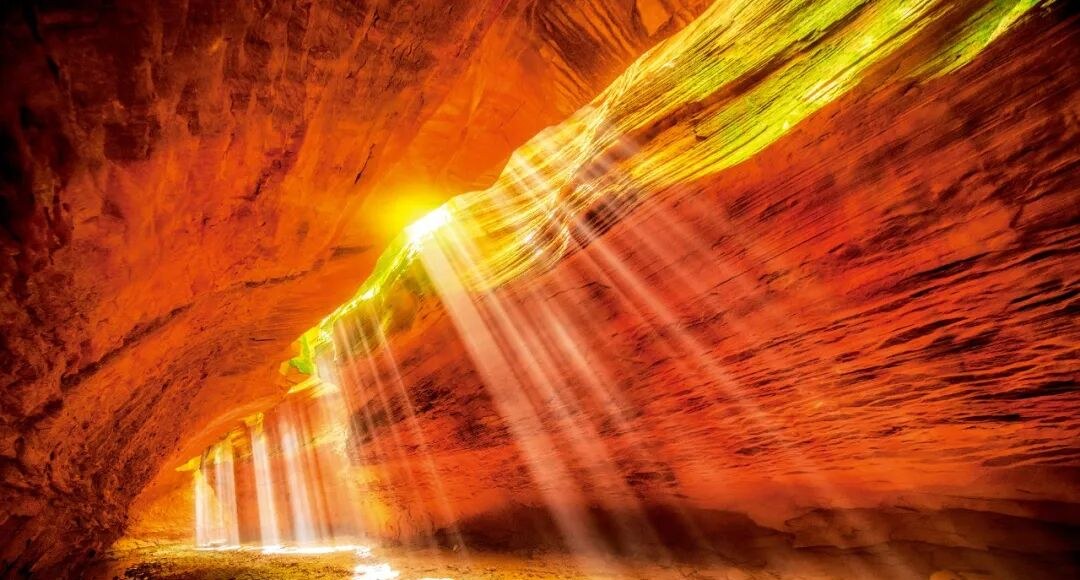
◎ Valley-type Danxia Landforms in Northern Shaanxi
Although the valley-type Danxia landforms in northern Shaanxi have not been designated as a World Heritage site, some of them are no less impressive than the Antelope Canyon in Page, Arizona, USA, in terms of geomorphology: they feature similarly winding cliffs on both sides and equally varied angles of incoming light. It’s just that these valleys in northern Shaanxi have only begun to draw public attention in recent years, so their beauty has long remained “hidden in plain sight.” ( Inscribed as a World Heritage Site in 2014
Construction began in 486 BC
Comprising three sections:
The Sui-Tang Grand Canal, the Beijing-Hangzhou Grand Canal, and the Eastern Zhejiang Grand Canal
Stretching 2,700 kilometers
Spanning more than 10 degrees of latitude
The Grand Canal is a classic example of a “linear cultural heritage”—
A special type of cultural heritage,
And a physical embodiment of Chinese history and culture.
It records over a millennium of civilizational traits
And regional diversity since the Sui-Tang dynasties.
It links two core areas of ancient Chinese civilization, the Yellow River and the Yangtze River,
And connects the most concentrated and dense cultural zones—
Qilu, Zhongyuan, Yan Zhao, and beyond.
This is more than just a river.
It is a cultural belt, a corridor of heritage,
A gallery showcasing Chinese civilization.
To grasp the essence of Chinese culture, a journey along the canal is enough.
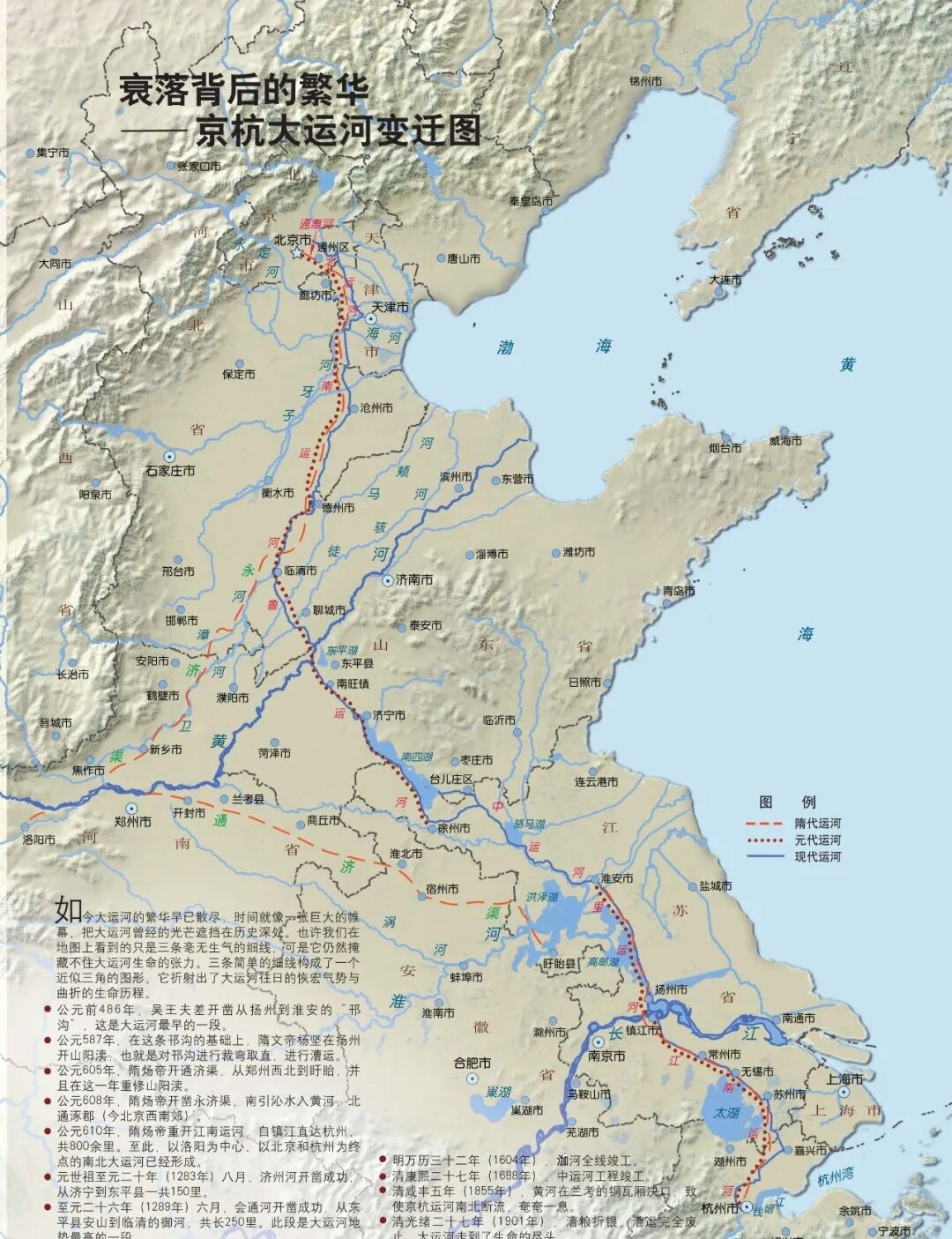
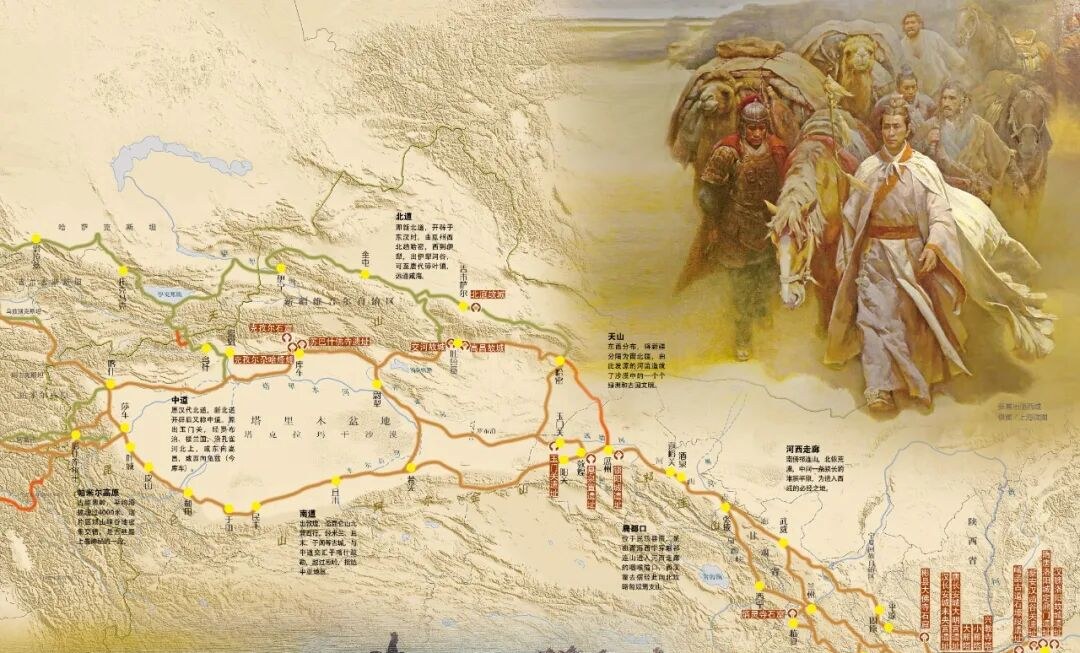
Photo from Chinese National Geography, May 2006The Silk Road
Inscribed on the World Heritage List in 2014
In 1877,
German geographer Ferdinand von Richthofen, in his book China,
first introduced the concept of the “Silk Road.”
However, on Richthofen’s map,
the Silk Road was imagined as a single route.
In reality,
after the Han Dynasty opened up the Western Regions and established the northern and southern routes of the Silk Road,
later generations continuously opened new northern routes and other paths,
making the Silk Road network increasingly dense.
The development of these routes
was also influenced by several major natural geographic features.
For over two thousand years,
this road chronicled the history of exchanges between China and the West.
In June 2014,
China, Kazakhstan, and Kyrgyzstan
jointly succeeded in nominating
the “Silk Roads: the Routes Network of Chang’an-Tianshan Corridor”
as a World Heritage site.
Among these, 22 sites are located within China,
covering palaces, grottoes, ancient cities, beacon towers, and many other historic relics.
Image from Chinese Heritage, March 2018Liangzhu Archaeological Site
Inscribed as a World Cultural Heritage in 2019
Some foreign scholars
do not recognize that Chinese civilization has a history of five thousand years,
believing that the Yinxu culture is the earliest civilization in China.
To this, archaeologist Mr. Xia Nai said:
“If this marks the birth of Chinese civilization,
it would be a bit like the legendary Laozi,
who was born with a white beard.”
No sooner had Mr. Xia Nai spoken
than the “deeply hidden” ancient Liangzhu kingdom came forth to bear witness.◎ Liangzhu Culture: “People Grouped by Status”
The Liangzhu Culture (3300-2300 BCE), centered around the Liangzhu site cluster in Yuhang, Hangzhou, is distributed across the Lake Taihu region. It extends north to the Yangtze River, west to the Nanjing-Zhenjiang area and the hilly regions of western Zhejiang along the middle Qiantang River, and south to the coastal areas of eastern Zhejiang beyond the Qiantang River, reaching as far as the Zhoushan Islands. To date, archaeologists have discovered over 600 Liangzhu culture sites in the Lake Taihu region. The marked locations in the map are key representatives, created based on exhibits from the Liangzhu Museum. In terms of site type, significance, scale, and the quality of unearthed jade artifacts, these settlements can be divided into four tiers. From the first-tier Liangzhu ancient city to the fourth-tier sites like Miaoqian and Taoyuan, the social status of the inhabitants decreases step by step, indicating that social differentiation during the Liangzhu period had reached a considerable level of complexity. (Map from Chinese Heritage, June 2019)
An ancient tomb, some fine jade, a palace complex…
For over half a century
“Liangzhu” has been unraveling its secrets bit by bit
It wasn’t until the early this century, when the massive city walls emerged,
that people finally ended their “blind men touching an elephant” exploration
and saw clearly the capital of this Neolithic kingdom.
It is solid evidence of China’s five-thousand-year civilization,
worthy of being called “China’s First City.”◎ The terrain and landscape are all well-suited
Looking down at this restoration of the ancient city of Liangzhu, the square and grand central palace area is striking. The city walls, square with rounded corners, provide tight protection, and at the diagonal corners, two hills—Fengshan and Zhishan—serve as natural watchtowers. The waterways within the city are densely arranged yet orderly, connected to the outer water network through eight water gates, offering convenient and swift transportation. This epoch-making urban planning is truly astonishing. (Image from “Chinese Heritage” June 2019 issue)
World Heritage Sites
Are rare and irreplaceable treasures of humanity,
Recognized by all as having outstanding universal value,
Including cultural relics, monuments, and natural landscapes.
In 1985,
China joined the “Convention Concerning the Protection of the World Cultural and Natural Heritage.”
Currently, China boasts 55 World Heritage Sites,
Among them,
37 World Cultural Heritage Sites
World Cultural Heritage
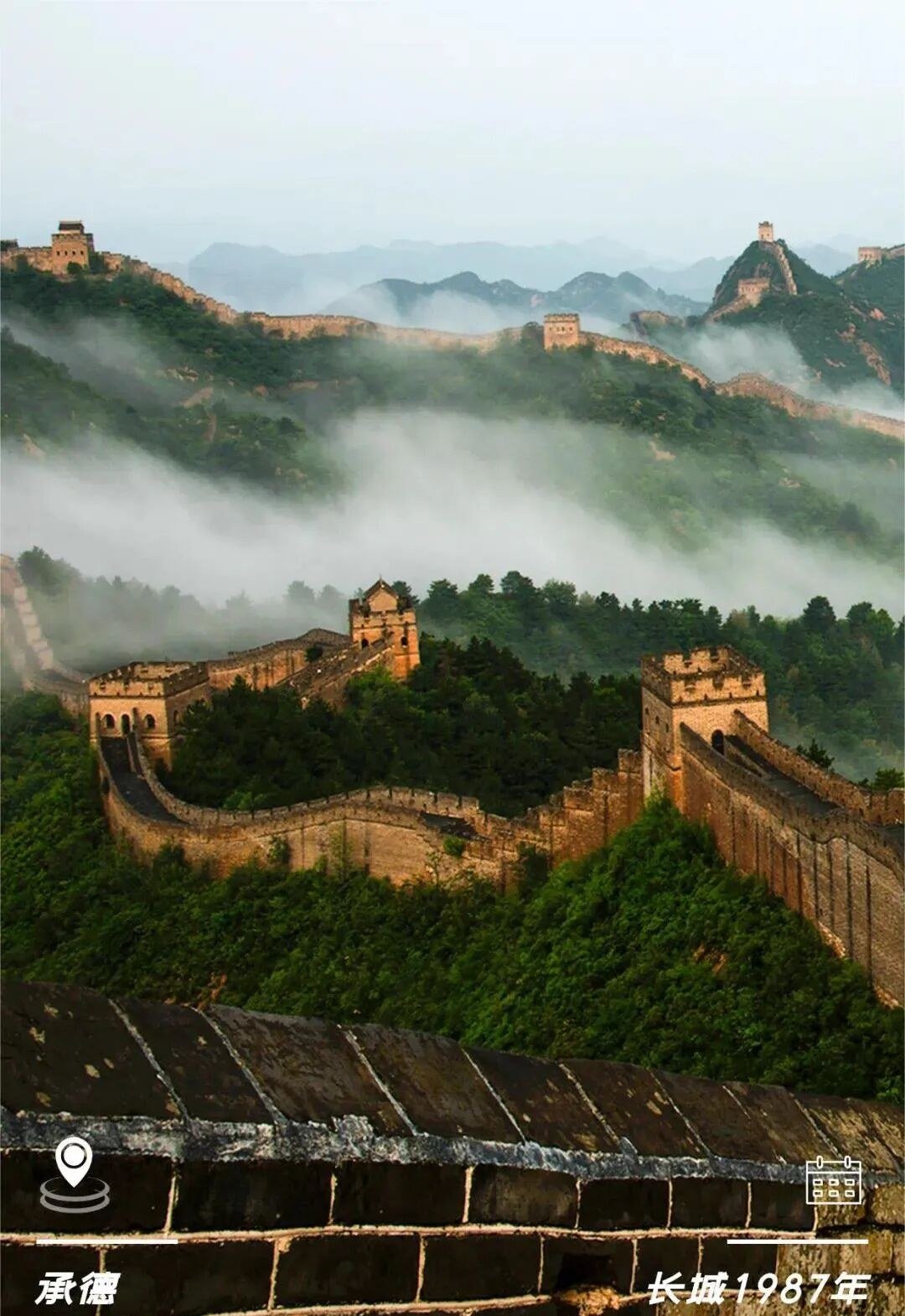
The Great Wall (1987.12)
Mogao Caves (1987.12)
Imperial Palaces of the Ming and Qing Dynasties
(Beijing’s Forbidden City, 1987.12; Shenyang’s Imperial Palace, 2004.7.1)
Mausoleum of the First Qin Emperor and Terracotta Warriors (1987.12)
Peking Man Site at Zhoukoudian (1987.12)
Potala Palace (Jokhang Temple, Norbulingka) (1994.12)
Mountain Resort and its Outlying Temples in Chengde (1994.12)
Temple and Cemetery of Confucius and the Kong Family Mansion in Qufu (1994.12)
Ancient Building Complex in the Wudang Mountains (1994.12)
Lushan National Park (1996.12.6)
Old Town of Lijiang (1997.12)
Ancient City of Pingyao (1997.12)
Classical Gardens of Suzhou (1997.12)
Temple of Heaven (1998.11)
Summer Palace (1998.11)
Dazu Rock Carvings (1999.12)
Longmen Grottoes (2000.11)
Imperial Tombs of the Ming and Qing Dynasties
(Xianling Tomb, 2000.11; Ming Xiaoling Tomb, 2003.7; Three Imperial Tombs of Shengjing, 2004.7)
Mount Qingcheng and Dujiangyan Irrigation System (2000.11)
Ancient Villages in Southern Anhui (Xidi and Hongcun) (2000.11)
Yungang Grottoes (2001.12)
Capital Cities and Tombs of the Ancient Koguryo Kingdom (2004.7.1)
Historic Centre of Macao (2005.7.15)
Yin Xu (2006.7.13)
Kaiping Diaolou and Villages (2007.6.28)
Fujian Tulou (2008.7.7)
Mount Wutai (2009.6.26)
“Historic Monuments of Dengfeng in ‘The Center of Heaven and Earth’” (2010.8.1)
West Lake Cultural Landscape of Hangzhou (2011.6.24)
Site of Xanadu (2012.6.29)
Cultural Landscape of Honghe Hani Rice Terraces (2013.6.22)
Grand Canal (2014.6.22)
Silk Roads: the Routes Network of Chang’an-Tianshan Corridor (2014.6.22)
Tusi Sites (2015.7.4)
Zuojiang Huashan Rock Art Cultural Landscape (2016.7.15)
Kulangsu: Historic International Settlement (2017.7.8)
Liangzhu Archaeological Site (2019.7.6)
4 Mixed Cultural and Natural Heritage Sites
World Heritage - Mixed Property
Mount Taishan (1987.12)
Mount Huangshan (1990.12)
Mount Emei and Leshan Giant Buddha (1996.12)
Mount Wuyi
(Nanping, Fujian, 1999.12; Shangrao, Jiangxi, 2017.7.10)
14 World Natural Heritage Sites
World Natural Heritage
Huanglong (1992.12.7)
Jiuzhaigou (1992.12.7)
Wulingyuan (1992.12.7)
Three Parallel Rivers (2003.7.2)
Sichuan Giant Panda Sanctuaries (2006.7.12)
South China Karst
(Kunming, Yunnan; Qiannan, Guizhou; Chongqing, 2007.6.27; Chongqing; Qiandongnan, Guizhou; Guilin and Hechi, Guangxi, 2014.6.23)
Mount Sanqingshan (2008.7.8)
China Danxia (2010.8.1)
Chengjiang Fossil Site (2012.7.1)
Xinjiang Tianshan (2013.6.21)
Shennongjia (2016.7.17)
Hoh Xil (2017.7.7)
Mount Fanjingshan (2018.7.2)
Migratory Bird Sanctuaries along the Coast of Yellow Sea-Bohai Gulf of China (Phase I) (2019.7.5)
Based on form and nature,
World Heritage can be classified into
Tangible Heritage
(Cultural Heritage, Natural Heritage, Mixed Cultural and Natural Heritage)
and Intangible Cultural Heritage.
This year, China’s “Cultural and Natural Heritage Day”
Has the theme “People’s Intangible Heritage, Shared by the People”
“Intangible Cultural Heritage” (ICH) refers to “intangible cultural heritage” (non-material heritage),
As opposed to tangible cultural heritage,
Together referred to as “cultural heritage,”
It encompasses
Various traditional cultural expressions
That are passed down from generation to generation
And regarded as part of their cultural heritage,
As well as the artifacts and spaces related to these expressions.
For example,
Traditional oral literature and the language that conveys it,
Traditional fine arts, calligraphy, music, dance,
Drama, opera, and acrobatics,
Traditional craftsmanship, medicine, and calendars,
Traditional rituals and festive customs,
Traditional sports and recreational activities…◎ Kunqu Opera The Peony Pavilion
Kunqu is one of the oldest and most influential forms of Chinese opera, popular in many regions of China. Its singing style is highly artistic and has had a huge impact on all modern Chinese opera forms, such as Sichuan opera and Peking opera. In May 2001, Kunqu was recognized by UNESCO as a “Masterpiece of the Oral and Intangible Heritage of Humanity” (and was inscribed on the Representative List of the Intangible Cultural Heritage of Humanity in 2008). ( Recently, the State Council approved and published the fifth batch of representative items of the national intangible cultural heritage list. 103 items from 96 former national-level poverty-stricken counties, such as Tuhetuyi embroidery and Songtao Miao embroidery, were included. Some items that serve people’s livelihoods and benefit the public, such as Shaxian snacks and Liuzhou river snail rice noodles, were also added.Image from China National Geographic, February 2021
As of now,
China has a total of 1,557 national-level intangible cultural heritage representative items,
including 167 in folk literature, 189 in traditional music,
144 in traditional dance, 171 in traditional opera,
145 in folk art forms, 109 in traditional sports, games, and acrobatics,
139 in traditional fine arts, 287 in traditional craftsmanship,
23 in traditional medicine, and 183 in folk customs.
China has
a total of 42 items
inscribed on
the UNESCO
Intangible Cultural Heritage Lists.
China’s natural environment
and its millennia of history
hold immeasurable value.
The key to “heritage” lies in the word “heritage” itself, not in “property.”
Property can be easily created,
but heritage cannot be made today.
Cultural heritage
is a non-renewable resource passed down from our ancestors.
Natural heritage
is a resource in its relatively pristine state,
undamaged by human production and daily life.
If these heritages are destroyed,
they can never be regenerated.
What can be regenerated is not heritage.
Heritage can only be protected, not recreated.
Want to know more
about “Cultural and Natural Heritage”?
Let China National Geographic give you an in-depth interpretation.
Click on the cover image to view and purchase the digital edition of the magazine.
China National Geography 2003 Issue 08
-
The Great Wall is the Spine
-
The Great Wall: Built Along Natural Boundaries
-
Interpreting the Great Wall on Ancient Maps
-
The Great Wall as a Father**“Chinese National Geography”** 2006 Issue 05
-
Beijing-Hangzhou Grand Canal: An Epic on the Land
-
Grand Canal Forum
-
The Grand Canal: The Wisdom of River Engineers Flows OnChina National Geography Issue 10, 2011
-
The Grand Beauty of Karst
-
We Witnessed the Wonders of China’s Caves Together
-
Canyons: The Pathways to the Karst KingdomChina National Geographic, Issue 06, 2004
-
Chinese Culture and World Heritage
-
Making History Tangible
-
Cultural and Natural Heritage Are Not for Consumption
-
China National GeoparksChinese Heritage Magazine, Issue 06, 2010
-
Why are bronze artifacts green?
-
The wealth of our cultural relics
-
Distribution map of China’s immovable cultural relics and World Heritage sites**“Chinese Heritage” September 2015 Issue**
-
The Beauty of the Forbidden City at Every Moment
-
Their Forbidden City
-
Imperial Transitions, Three Name Changes
-
Overlooked Details of the Forbidden City**“Chinese Heritage” March 2018 Issue**
-
Walking on the Silk Road
-
Hangu Pass: The First Pass Westward
-
The Four Garrisons of Anxi: The Western Frontier of the Tang Empire
-
Kashgar: The End of China, the Heart of AsiaChinese Heritage Issue 06, 2019
-
The Testimony of the Liangzhu Ancient Kingdom
-
Liangzhu Ancient City: The Dream of a Great Nation Five Thousand Years Ago
-
How Liangzhu Craftsmen Made Jade Artifacts
Want to see more digital magazine editions?
Now enter the “China National Geography EasyRead” mini-program
** Up to 40% off • Save ¥10 for every ¥100 spent **
Offer ends June 21, 2021
Don’t miss out
Want to buy books published by Chinese National Geography?
Looking for great products and gifts?
Go to the “Chinese National Geography Premium” mini-program
** 15% off on all items **
** Offer valid until June 21, 2021 **
Don’t miss out
- < End > -
Editor | Xiao Rou
Geo君 is waiting for you hereShop for great findsReading magazinesRoaming the WorldDiscover Beauty
Share Collect Like Wow
At least I gotta have one, right?
Tag navigation
Explore articles that share the same tag and jump to tag pages.
Category navigation
Jump to the article’s category or explore nearby topics.
Das chinesische "Welterbe" im Film, wie viel kennst du davon?
Jump to the more recent article in this topic series.
Vollständig! Die schönste Version Chinas, inklusive Berge, Flüsse und Seen
Continue to the previous article in this series.
Related stories
More articles from the same category and nearby topics.